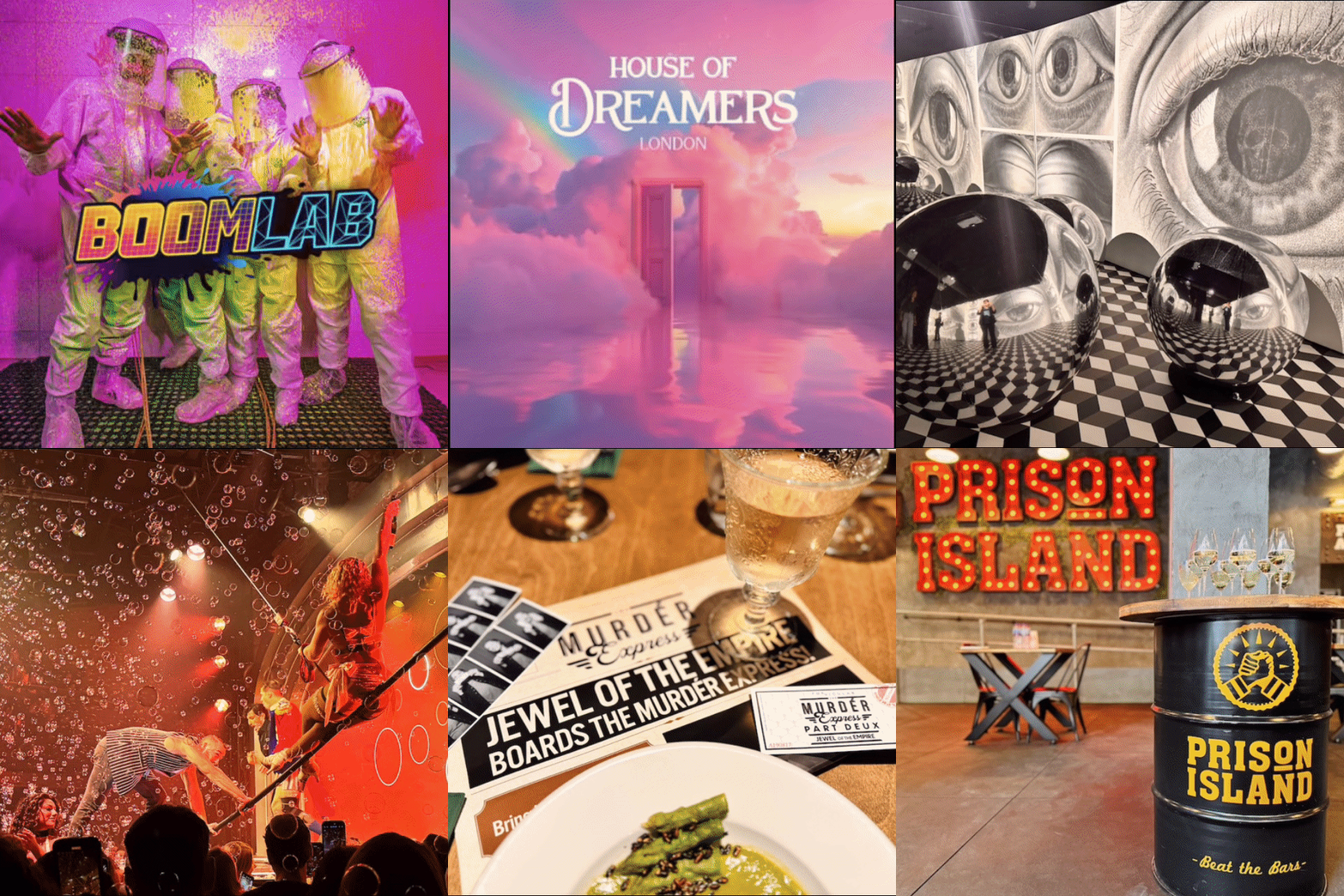
A massive heatwave has reached London for this week and the next. Here are 10 indoor activities and exhibitions with air conditioning to escape the hottest days.
Plus, you can enjoy 10% DISCOUNT on ALL these experiences! Just enter code ADVENTURERLDN10 at the checkout.
You’ll explore a life-size 3D virtual model of the space station, meet legendary astronauts and embark on your own spacewalk.
House of Dreamers
Image in courtesy of Fever UK
Escape reality and step in the magical world of your dreams: House of Dreamers.
Explore 16 immersive rooms, wander through a fairytale forest, have fun in a giant pink ball pit, board on the Dream Train, swing above the clouds and create unforgettable memories.
Boom Lab
Image in courtesy of Fever UK
Garb your squad and head to London’s No. 1 group gaming experience, Boom Lab!
Form your team (2 to 16 people), dodge lasers, smash glowing targets, leap over lava and end your experience with a massive colour-exploding blast!
SABRAGE
Photo: Urban Adventurer
SABRAGE is London’s hottest circus-theatre experience that brings vintage glamour, and risqué humour. Enjoy cheeky, high-energy entertainment with a cool champagne in one hand and Southern-style bites in the other. It’s not just a show, it’s a seductive spectacle. It’s your next obsession.
The Murdér Express: Part Deux, The Jewel of the Empire
Photo: Urban Adventurer
This incredible murder mystery comedy theatre is combined with a three-course fine dining menu.
The Murdér Express: Part Deux, The Jewel of the Empireis transporting the world’s biggest diamond, The Jewel of Empire, via Pedley Street station’s Murdér Express. Soon the jewel is missing, and bodies begin to pile up. Will the killer ever be caught? The clock is ticking!
Paradox Museum
Photo: Urban Adventurer
Paradox Museumis one of London’s most popular family destinations.
50+ immersive paradoxes and mind-bending illusions that trick your perceptions and challenge your reality.
Plus, K-POP Sunday brings the K-POP energy into the museums for kids. Expect, dance workshops, styling moments, body art and plenty of surprises. 28 June, from 9am – 12:30pm.
M.C. Escher – The Exhibition
Photo: Urban Adventurer
M.C. Escher is often called ‘The master of illusions’ for his impossible structures, mind-bending illustrations. M.C. Escher – The Exhibition blends geometry and mathematics together to create surreal imagery, infinite patterns and visual paradoxes.
Ramses and the Pharaohs’ Gold: The Exhibition
Photo: Urban Adventurer
Come face to face with the original wooden coffin of Ramses II. Ramses and the Pharaohs’ Gold: The Exhibitionis featuring 180 original treasures, each over 3000 years old straight from the Egyptian Museum, Cairo.
Fun fact: Brandon Fraser recently visited the exhibition.
Explore 10 immersive rooms, including a GIANT ball pit with oversized inflatable toys, embark on a virtual hot air balloon flight, have fun in the balloon pit filled with balloons to the ceiling, relax inside a giant colourful soap bubble, enjoy a magical VR experience and so much more!
Cleopatra: The Immersive Experience
Photo: Urban Adventurer
Meet the last Great Queen of Egypt and discover her life, reign and legacy. Get close to real artefacts, learn more about her lifestyle, hair and makeup through magic mirrors, enjoy a 360 degree immersive room, a hologram experience and a free roam VR experience. Cleopatra: The Immersive Experience must end on the 12th July!
+1 Prison Island: The Ultimate Action Game
Photo: Urban Adventurer
Team up in groups of 2 – 5 and take on 31 thrilling challenge cells.
Prison Island: The Ultimate Action Gamewill challenge your stamina, problem solving skills, logic and – of course – team work. You have 90 minutes and the clock is ticking. Can you solve all the challenges? Perfect for families or friend groups.
[BLOG POST IN BIO] Anish Kapoor at Hayward Gallery After three decades, Anish Kapoor has returned to Hayward Gallery with a monumental exhibition. His works turn the world upside down, distort and twist, and transform exhibition spaces into places where your sense of scale, and even gravity begin waver 🕳️ #anishkapoor#CapCut
Vantablack, Distorted Mirrors, Giant Balloons, Upside Down Mountain
Photo: Urban Adventurer
After three decades, Anish Kapoor has returned to Hayward Gallery with his monumental exhibition taking all the exhibition rooms and the terraces. This exhibition is also the centrepiece of the Southbank Centre’s 75th anniversary programme and the final exhibition curated by Ralph Rugoff as a Director of the Hayward Gallery for 20 years.
Over his career, Anish Kapoor has become known for his breath-taking, monumental installations. His works turn the world upside down, distort and twist, and transform exhibition spaces into places where your sense of scale, and even gravity begin waver.
Giant Red Balloons – All of Nothing
Photo: Urban Adventurer
Your exhibition journey starts in a room almost entirely filled with a giant red balloon.
The monumental installation leaves very little room for the visitors as it almost fills the whole room. It’s so vast, you can only see the whole thing if you climb the spiral staircase.
The giant balloon represents the tension between the opposites which Kapoor calls: All of Nothing. The balloon takes up almost the entire space, but at the same time, it’s filled with air, meaning – in reality – it’s nothing because if we pop the balloon, nothing is left.
Photo: Urban Adventurer
Similar red balloons appear in the final room of the exhibition where an upside down mountain is floating from just inches above the ground.
The Blackest Black Material in the World
Photo: Urban Adventurer
In the next room, visitors have the rare opportunity to encounter installations made from Vantablack, the blackest known substance in the world.
Vantablack absorbs 99.965% of light, creating the blackest black material possible.
It’s not paint. It’s a special material developed by nano technology: billions of vertically aligned carbon nanotubes are tightly packed together, so when the light hits the surface, it becomes trapped between the tubes.
Photo: Urban Adventurer
Only a very few artists are allowed to use this material, and Anish Kapoor is one of them, meaning it’s a very rare opportunity for visitors of the exhibition to experience Vantablack.
With Vantablack, Kapoor creates seemingly depthless voids and mysterious vertigos that you feel like pulling you in like a black hole.
Photo: Urban Adventurer
Kapoor uses Vantablack in numerous other installations, such as his monumental velvety rock formation in another room and his dramatic tissue-like sculptures that look like tribal ritual sacrifices.
Distorted Mirrors
Photo: Urban Adventurer
There are mirrored steelworks scattered on the walls and outside the terraces to trick your mind.
Photo: Urban Adventurer
They bend and twist the reflections of their surroundings, opening new, distorted dimensions.
Velvety Red Rock Formation
Photo: Urban Adventurer
A giant red rock formation takes up an entire exhibition room. It’s painted in Kapoor’s signature red, and it’s influenced by interesting rock formations Kapoor visited during his travels, including Uluru and the sandstone monolith in central Australia.
This artwork with a Vantablack piece in its centre suggests an otherworldly, mysterious landscape.
Upside Down Mountain
Photo: Urban Adventurer
A vast mountain is floating just inches above the ground surrounded with – what they look like – giant chopped meat chunks wrapped in transparent plastic foil.
This installation is hovering between the edge of wander and horror.
The title of the artwork is ‘Mount Moriah’ which in the Old Testament is described as the place where God commanded Abraham to sacrifice his son Isaac.
About Sir Anish Kapoor
Photo: Urban Adventurer
Sir Anish Kapoor is one of the most influential artists today. He is known for his monumental public sculptures and mind-bending illusions.
One of his most famous works is the Cloud Gate (2006) or ‘The Bean’ located in the Millennium Park in Chicago. It’s a vast stainless steel sculpture that reflects its surroundings back like a giant mirror.
Another one is the famous 114.5-metre tall ArcelorMittal Orbit in Queen Elizabeth Olympic Park commissioned as a landmark and legacy piece for the 2012 London Olympic Games.
Anish Kapoor’s Signature Red
Photo: Urban Adventurer
Kapoor often uses his signature red in his works. Red is a colour infused with emotion and ceremonial associations.
He says: “This open and visually beckoning colour also associates itself with a dark interior world. I try to make a condition of colour, not a painted surface. I want to make something that’s red in such a way that its redness occupies the whole space of your vision.”
Ready for your next adventure? If you love mind-bending illustrations and immersive rooms, M.C. Escher – The Exhibitionis now open at Somerset House. Book with Fever and use code ADVENTURERLDN10 to get 10% OFF!
Australian-born filmmaker, speculative architect and director, Liam Young, invites us to step into the future and imagine what humanity could look like. ‘In Other Worlds’takes us to an imaginary journey to experience six different possibilities.
[BLOG POST IN BIO] 🌏 What humanity could look like in the future? How the decisions we make today shape your future? 👩🚀 𝙄𝙣 𝙊𝙩𝙝𝙚𝙧 𝙒𝙤𝙧𝙡𝙙𝙨 𝙗𝙮 𝙇𝙞𝙖𝙢 𝙔𝙤𝙪𝙣𝙜 at @Barbican Centre • Six immersive rooms • Six different visions 🗓️ When 21st May – 6th September 2026 📍Where Barbican Centre – The Curve | Silk St, Barbican, London EC2Y 8DS 🎟️ Tickets Standard adult ticket: £20.50 Kids (6 – 15): £7.50 Kids under 5: Free #barbican#future#humanity#liamyoung#CapCut
“Operating in the spaces between design, fiction and futures, these works immerse us in the consequences and opportunities of the decisions we make today. It is about stepping away from dystopia, asking: what if the future could actually be…hopeful?” – says the description of the exhibition at the Barbican Centre.
Having been described as “the man designing our futures” by BBC, Liam Young is best-known for his richly detailed moving image installations, world-building projects and architecture collaborations.
Six Immersive Rooms Predicting Six Different Futures
Photo: Urban Adventurer
There are six different rooms to explore, each predicting a different future for humanity.
One room imagining a monstrous city with 10 billion people and 7,000 different languages which is also a 24/7 party zone as annual celebrations, festivals and carnivals of different communities overlap.
In another imaginary world, a whale swims through the ruins of a flooded AI data centre, while in a 360 degree projection space, you’ll find yourself surrounded by a vast ocean from which a huge carbon capturing machine emerges.
Photo: Urban Adventurer
Huge scale projections, costumes, audio stories, film and soundscape help visitors fully soak up the alternative futures in each room.
‘In Other Worlds’ has been created with the collaboration of famous filmmakers, designers, actors and directors, including Maggie Aderin (host of BBC’s Sky at Night), Adam Young (Lord of the Rings: The Rings of Power), Emmy-nominated costume designer Ane Crabtree (The Handmaid’s Tale, The Sopranos, Westworld), writer Lisa Joy (Westworld, Fallout) and Chen Qiufan (AI 2041), just to name a few.
Photo: Urban Adventurer
As the exhibition breaks new ground in terms of new ideas and experiences, it also takes visitors beyond the regular exhibition spaces. It ends at Barbican’s car park, suggesting there are no boundaries of imagination and ideas.
Photo: Urban Adventurer
“This show is a not collection of solutions, but rather it’s an attempt to re-orientate us around new visions for a future that operate at planetary scales. The crises we face, they’re no longer crises of technology, but rather they’re crisis of the imagination.” – says Young.
Ready for your next adventure? Michelangelo’s Sistine Chapel: The Exhibition has finally arrived in London. 34 reproduced frescoes are on display using a special technique that allows visitors to see every brushstroke! Licenced and approved by the Vatican Museum.
Book with FEVERand use discount code ADVENTURERLDN10 to get 10% OFF!
New interactive family-friendly experience opened at the National Maritime Museum Greenwich. ‘Astronomers Take Over’gives visitors a rare chance to meet real astronomers, ask their questions, see mind-blowing demonstrations and experience how the Universe really is.
[BLOG POST IN BIO] Astronomers Take Over at the National Maritime Museum Greenwich 🚀🪐✨🧑🏻🚀 ‘Astronomers Take Over’ gives visitors a rare chance to meet real astronomers, ask their questions, see mind-blowing demonstrations and experience how the Universe really is 🪐✨ What to expect: • Galaxy room: It’s a gorgeous infinity room. Perfect for that Instagram moment! • A giant telescope installation you can step inside • Scavenger hunt for kids • Star Huddle: Learn what it really means when we say we are all made of stardust • Moon room • Astronomers Lounge • Lots of interactive elements kids will love + Planetarium experience (that’s extra charge) 📍 Where National Maritime Museum Greenwich | 9NF Romney Rd, London SE10 🗓️ When 27th March – 29th June 2026 🎟️ Tickets Astronomers Take Over + Planetarium ticket: £16 Astronomers Take Over (without Planetarium show): £8 #astronomerstakeover#astronomer#spacethings#familytimefun#familydayout
‘Astronomers Take Over’ opened on the 27th March and is a temporary gallery offering playful hands-on experience for anyone interested in space and astronomy.
Here are the highlights of the experience:
Galaxy Box
Photo: Urban Adventurer
Galaxy Box is an awe-inspiring infinity room designed with Sir Brian May and visual artist and astrophotographer, J-P Metsävainio for visitors to experience how vast and beautiful the Universe really is.
Perfect for that Instagram moment!
Telescope
Photo: Urban Adventurer
Step inside a giant telescope and learn more about major space discoveries through the past 350 years connected to the Royal Observatory Greenwich.
Telescope is designed to inspire the next generation of astronomers who could be you!
Cosmic Quest
Photo: Urban Adventurer
Kids will love this very interactive experience where they are invited for a scavenger hunt.
The mission is to find weird hidden objects astronomers have taken into space. Think of a gorilla suit, Luke Skywalker’s light sabre and an espresso machine.
Star Huddle
Photo: Urban Adventurer
What does it really mean when we say we are all made of stardust?
Meet the Royal Observatory’s Head of Astronomy, Liz Avery and the team and take a closer look to the stars using a spectroscope.
Moon Room
Photo: Urban Adventurer
You’ve probably seen the out-of-this-world images of the dark side of the Moon; the crew of the Artemis II mission had taken.
In the Moon Room, you can learn more about how our planet and the Moon move and dance around each other through space.
Land a Mars Rover at a Martian Crater
Photo: Urban Adventurer
Join Professor Sanjeev Gupta and his team and work together on some of the humankind’s most amazing space missions.
Did you know that Mars rovers are operated from the Earth and you can even do that from a kitchen at home?
Well, here’s your chance to operate a Mars rover and try to land it at a Martian crater.
Astronomers’ Lounge
Are you following the Artemis II mission? Fascinated by the newest space discoveries?
Pull up your chair and discuss the latest space news with the Royal Observatory’s astronomy team. Here’s your chance to get your questions answered by real astronomers.
Planetarium Experience
Why not add a Planetarium experience to your ticket and enjoy a 30-minute awe-inspiring show about our solar system or an adorable film about ‘Animals in Space!’ perfect for younger visitors?
Coming Soon: Mirror Moon by Luke Jerram
Celebrating 350 years of studying the Moon, a giant Mirror Moon will arrive at the Royal Observatory this May.
The Mirror Moon is a 2m in diameter scale model of our Moon, designed and created by British artist, Luke Jerram, famous for his large scale art projects (Gaia, Mars, Sun, Moon).
Mirror Moon is a touchable installation created using highly accurate topographical NASA data of the lunar surface.
Feel free to run your fingers on craters, valleys, mountains and million years old lava fields.
How to visit Luke Jerram’s Mirror Moon?
Simply book a ticket to the Royal Observatory online. Your ticket includes the visit of the Mirror Moon.
NOTE:Astronomers Take Over is closed on most Tuesdays and Fridays.
It’s open on all other days from 10am – 5pm
Tickets
Book your ticket on the Royal Museums of Greenwich’s official website.
Astronomers Take Over + Planetarium ticket: £16
Astronomers Take Over (without Planetarium show): £8
Ready for your next adventure? Fairy Tales exhibition at the British Library. This magical exhibition is full of interactive elements kids will love. It explores the origins of fairy tales and how the stories have changed over time. Visit a gingerbread house, sit with the Three Bears, smell portions, look into a magic mirror and make a wish from Aladdin’s Genie.
British Museum’s new exhibition shines light on the historical relationship between Hawai’i and the United Kingdom. There are 150 artefacts on display including a letter King Kamehameha I sent to King George III, sculptures, weapons made from shark teeth and a feathered cloak worn by chiefs.
[BLOG POST IN BIO] 𝙃𝙖𝙬𝙖𝙞’𝙞: 𝘼 𝙆𝙞𝙣𝙜𝙙𝙤𝙢 𝘾𝙧𝙤𝙨𝙨𝙞𝙣𝙜 𝙊𝙘𝙚𝙖𝙣𝙨 exhibition at The British Museum British Museum’s new exhibition shines light on the historical relationship between Hawai’i and the United Kingdom 🌺 What to expect: • 150 artefacts including a letter King Kamehameha I sent to King George III • Rare artefacts, sculptures, weapons made from shark teeth and feathered cloaks worn by chiefs • The poignant story of King Kamehameha II and his wife’s ill-fated visit to the UK in 1824 …and more! 📆 15th January – 25th May 2026 🕰️ Open daily from 10am – 5pm (Fridays 8:30pm) 🎟️ Tickets can be booked on British Museum’s official website #hawaii#britishmuseum#historytime#historylovers#CapCut
Having been built for years in collaboration with native Hawaiian artists and knowledge-bearers, ‘Hawai’i: A Kingdom Crossing Oceans’exhibition shines light to the lesser-known side of the relationship between Hawaii and the United Kingdom.
The exhibition showcases over 150 objects, including contemporary artworks made by Hawaiian artists, rarely seen international loans and a fathered cloak with a remarkable story.
An Ill-Fated Royal Visit
Photo: Urban Adventurer
In the 18th century, the presence of foreign powers increased in Hawaii. Chief of Hawaii Islands, Kamehameha I unified the entire archipelago and became the first king of Hawaii.
Kamehameha I was known to be a remarkable strategic leader who nurtured relationships with foreign powers. Hoping for protection from the United Kingdom King Kamehameha I sent a long cloak made from hundreds of thousands of tiny feathers to George III in 1810 with a letter asking for protection against foreign powers.
The gift was received by the Prince Regent due to the king’s mental illness and displayed in Carlton House as a “Curious Feather Coat Sent by King of the Sandwich Islands”.
In return, King Kamehameha I only received vague promise of support and a gold-laced cocked hat.
Years later, King George III and King Kamehameha I died and succeeded by their eldest sons, George IV and Kamehameha II – also known as Liholiho.
LihoLiho sent a letter to George IV but after 3 years passing, he didn’t receive reply. Although, travelling to Hawaii from the UK it takes around 17 hours today, back in the 19th century, it took 2 long years for LihoLiho’s letter to arrive to the United Kingdom.
In 1823 LihoLiho embarked on a journey to the United Kingdom to seek alliance. He travelled with his wife, Kamāmalu (also known as Tamehamalu) and a delegation of 11 people.
Photo: Urban Adventurer
The ship stopped in Rio de Janeiro where King LihoLiho presented another feather cloak to the Births consul resident, Sir Henry Chamberlain.
Tragically LihoLiho and his young queen caught measles shortly after arriving to the United Kingdom and both died before ever had the chance to meet the British king.
Highlights of the Exhibition
Silver and ivory teapot. London, England 1824-25
Photo: Urban Adventurer
Following the tragic death of King LihoLiho (Kamehameha II) and his wife Queen Kamāmalu, their ship went back to Hawaii with the remains of the late king and queen.
Arriving in Honolulu in May 1825, British officials presented gifts to the Hawaiian royal family. This silver teapot was one of them. It was presented to Kuhina Nui (Ka’ahumanu), the wife of the late king Kamehameha I, and regent.
The engraved pot shows the British arms on one side and the name of the recipient on the other.
Charles Josheph Hullmandel (1789 – 1850), after John Hayter, Na Poki, Prime Minister of the Sandwich Islands; and his wife, Liliha. Lithograph, 1824
Photo: Urban Adventurer
This lithograph showcases the Governor of O’ahu and his wife, high chiefess Liliha, as sitting for an official portrait in London. The picture was created during the visit of a Hawaiian royal delegation to London in 1824 to introducing Hawaiian culture and present Hawaiian leader as sovereign figures on the global stage.
They’re both wearing Hawaiian garments, including a feathered cloak and helmet, barkcloth, and whale-tooth necklace.
‘Ahu’ula (cloak), Maui, Hawai’i
Photo: Urban Adventurer
This red and yellow feather cloak was made before 1778. It’s thought to have been the one presented by high chief Kahekili of Maui to British Captain Charles Clerke, who accompanied Captain James Cook on a voyage to Hawai’i between 1778 and 1779.
The cloak is made with millions of tiny bird feathers. The feathers were carefully harvested without killing the birds.
Mahiole hulu manu (feathered helmets), ‘ie’ie rootlet, olona fibre and feathers (‘I’iwi, ‘ō’ō, memo), Hawai’i, possibly late 1700s
Photo: Urban Adventurer
These helmets were worn in battles and ceremonies. They’re made from arial rootlets of the ‘ie’ie plant. Each mahiole is unique because different ways of waving are incorporated in the helmet to create a basket structure. Once the helmet shape was done, they attached small feathers to it creating the most different patterns.
Kapa (barkcloth), mulberry bast, Hawai’i, possibly late 1700s or early 1800s
Photo: Urban Adventurer
Kapa is a piece of barkcloth made from the inner bark of the paper mulberry tree. It was probably worn as the upper layer of a skirt (pā’ū). It’s decorated using a wooden liner tool (lapa) which they dipped in red and black pigment to draw the intricate patterns.
Wehi hulu (feathered ornament), ‘ie’ie rootlet, olona fibre, pearshell, wood, ‘I’iwi and ‘ō’ō feathers. Date unknown
Photo: Urban Adventurer
The name of this implement or ornament has not been historically recorded, neither the context of use. There are only a few examples of these items remained today.
Ki’i akua (god image) representing Kū, a god associated with warfare and governance. Late 1770 or early 1800s
Photo: Urban Adventurer
This sculpture is carved from a single piece of ‘ulu (breadfruit wood) and may have been brought to London by Hawaiian king LihoLiho in 1824.
This figure was likely stood on a place of worship (heiau) in Kona on the largest island of the Hawai’i archipelago.
‘Umeke ki’i (bowl with figure), kou wood, pearlshell, red ‘I’iwi red feathers, kapa (barkcloth) and dog fur. Possibly late 1700s
Photo: Urban Adventurer
This bowl is made from kou wood and was likely used to serve small portion of medicine or food. The carved figure probably represents a chiefly person in a serving position. The high status is indicated by the figure wearing feathered headdress and red malo (loincloth).
Japan House London launched its new exhibition, ‘Pictograms: Iconic Japanese Designs’ on the 30th July 2025. The exhibition delves deep into how pictograms have removed language barriers around the globe by creating a unique visual language everyone can easily understand.
Daikoku Daigo, Art Director and Graphic Designer at Nippon Design Centre (left) and Simon Wright Director of Programming, Japan House London (right)
Photo: Urban Adventurer
We went to the press preview of the exhibition where we had the opportunity to meet Art Director and Graphic Designer at Nippon Design Centre, Daikoku Daigo who gave us a deeper insight into how Japan has played an important role in development of this word-free global language and we learnt the step-by-step creation of pictograms.
[BLOG POST IN BIO] New exhibition at Japan House London 𝙋𝙞𝙘𝙩𝙤𝙜𝙧𝙖𝙢𝙨: 𝙄𝙘𝙤𝙣𝙞𝙘 𝙅𝙖𝙥𝙖𝙣𝙚𝙨𝙚 𝘿𝙚𝙨𝙞𝙜𝙣𝙨 🚻💟📳🈴 The exhibition delves deep into how pictograms have removed language barriers around the globe by creating a unique visual language everyone can easily understand 🛄♿️ The exhibition has been created in co-operation with Nippon Design Centre (NDC), a global design agency known for creating the first full set of sporting pictograms for the 1964 Tokyo Olympic Games. The pictograms later became the international standard for sporting events 🏊🏻♀️🚴🤺🏋️♀️ You can create your own pictogram at a lit up table or even be part of them by taking a selfie with one of the giant 3D pictograms! Pose under a Torii gate ⛩️ or next a sumo wrestler 🤼♂️ or take control of a giant pictogram train 🚆 📍 Japan House London | 101-111 Kensington High St, London W8 5SA (Closest station High Street Kensington) 📆 30th July – 9th November 2025 🎟️ FREE admission #japanhouselondon#pictogramas#japaneseculture#newexhibition#japanese#japan#CapCut
Whether we realise or not, we are guided by pictograms several times a day. Just think about the weather map on your phone, the pictograms on a parcel or even your beer can at the pub.
‘Pictograms: Iconic Japanese Designs’ exhibition has been created in co-operation with Nippon Design Centre (NDC), a global design agency known for creating the first full set of sporting pictograms for the 1964 Tokyo Olympic Games. The pictograms later became the international standard for sporting events.
Photo: Urban Adventurer
Did you know that the designing process started 5 years earlier in 1959?
Whilst at the exhibition, make sure you watch the interview with Nagai Kazumasa, graphic designer and advisor at the Nippon Design Centre, who will give you a glimpse into the creation of the famous pictogram collection and the challenges the artists faced during the designing process.
Throughout the decades, Nippon Design Centre has been involved in global projects and today has offices in Japan, Europe and North America.
From Cave Paintings to Emoji
Photo: Urban Adventurer
The exhibition delves deep into the history of visual communication, starting from 15,000 years old cave paintings made by early humans, to Egyptian hieroglyphs, to the Lascaux murals in France to today’s digital pictograms, the emoji.
As we can see, visual communication goes back to the earliest times of human history and is present till this day.
Pictograms are used everywhere from travel to tourist hot spots and maps to street signs to products labels and toilets. Pictograms – in fact – have become a critical role in global tourism and many other areas, making our everyday lives easier.
How travel signs would look like without pictograms
Photo: Urban Adventurer
Now, stop for a second and imagine a life without pictograms. Imagine how our lives would be without those simple little symbols. Without pictograms, we would have to read long texts displayed on boards at airports and stations and may even miss our trains because of that.
Japan’s Pioneering Role in Pictograms
3D Sumo pictogram
Photo: Urban Adventurer
Pictograms are created to inform and reassure in an easy-to-understand way regardless the language we speak or the country we are in and Japan’s pioneering role in the development of pictograms is undeniable.
Daikoku Daigo, Art Director and Graphic Designer at Nippon Design Centre (left) and Simon Wright Director of Programming, Japan House London (right)
Photo: Urban Adventurer
“When you see pictograms, you naturally understand where to go or how to use something, creating a sense of both security and freedom of movement. They are a ‘friendly point of contact’ between space and society.” – Daikoku Daigo, Art Director and Graphic Designer at Nippon Design Centre explains.
Photo: Urban Adventurer
The 1964 Tokyo Olympic Games was the first ever Olympic Games held in Asia. Visitors and athletes were expected from all over the world, and they needed to be able to navigate in a country whose language they didn’t speak.
That’s why multiple sets of pictograms were designed, helping visitors and athletes to find their way around Tokyo, and to be able to identify the different sports on the programme.
Nippon Design Centre have set up the standards for sporting pictograms that later were used all over the world.
Did you know that the word ‘emoji’ we use for digital pictograms also comes from Japan?
Letter ‘e’ means ‘picture’ and ‘moji’ means ‘character’. Emoji has been used to describe digital picograms from the 1990s.
Understanding the Essence of the Subject
Mind map for an apple
Photo: Urban Adventurer
Believe it or not, creating pictograms is a very complex process.
The artist needs to understand the core essence of the subject they want to work with. – explains Daikoku.
Let’s take an apple, for example. As the first step, the artist creates a mind map to visualise all the things an apple is connected with. They include colours and shapes, but also biblical meaning, like the forbidden apple in the Garden of Eden.
The artist has to keep in mind what essential information the pictogram needs to carry. The artist also needs to consider the size of the pictogram: will the pictogram be used in small scale or bigger scale? If the pictogram will be used in small scale, the designer eliminates all unnecessary details and elements to create a clear, easy-to-understand design that delivers harmony.
Photo: Urban Adventurer
If the pictogram represents a person and captures movement, such as walking or swimming, the movement will be broken down to frames (similarly to motion picture) and the artist needs to identify that one particular move that captures the essence of the action.
Create Your Own Pictogram | Be a Pictogram
Photo: Urban Adventurer
‘Pictograms: Iconic Japanese Designs’ has two fun interactive sections allowing visitors to create their own pictogram or even be part of one themselves.
You can create your own pictogram using a selection of elements and components provided. Select any elements you like, choose a theme and create your very own pictogram representing anything you like on the lit up table.
Create your own pictogram – interactive table
Photo: Urban Adventurer
You can even be part of a giant 2.5 metre tall pictogram by standing under a Torii gate sizing up to a sumo wrestler or taking control of a Japanese train.
London as a Pictogram
Photo: Urban Adventurer
As part of the exhibition, Japan House London ran a design competition among primary and secondary school pupils in collaboration with The Japan Society.
‘My Design’ program invited pupils to design their own pictogram representing a specific aspect of London important to them. The winning designs are featured as part of the exhibition.
About Japan House London
Photo: Urban Adventurer
Located in the heart of Kensington, Japan House London is the cultural home of Japan in the UK representing the very best of Japanese art, design, innovation, technology, and – with a lovely small café on the ground floor and a theatre cooking restaurant, called ‘AKIRA’ on the first floor – gastronomy.
Japan House London regularly hosts free exhibitions, workshops, talks, demonstrations, and screenings.
There are two other Japan Houses in the world: one in Los Angeles and one in São Paulo.
Shop
Photo: Urban Adventurer
Make sure you visit Japan House London’s shop where you can find not only exclusive exhibition-related products, but also Sake, stationery, artworks, kitchenware, handmade jewellery, books and more. All in the highest quality and straight from Japan.
Planning a holiday in Japan?
Why not visit Japan House London’s Travel Information Area on the ground floor? The Travel Information Area is run by the Japan National Tourism Organisation (JNTO). They can provide free guidance and recommendations on what to visit and when and provide additional materials, such as brochures to help planning your journey.
Ready for your next adventure? Enigmatic Japanese author, Uketsu’s new book, ‘Strange Houses’ is now available to purchase in the UK. We went to the press event hosted by Pushkin Press where we tried themed cocktails and ‘Strange Sushi’.
Japan is synonymous with exemplary design yet, it doesn’t have its own national design museum.
Seven leading Japanese designers with completely different disciplines were asked, “If there were a permanent Japanese design collection, what would you put in it?”. Their diverse responses are the subject of Japan House London’s newly opened exhibition: Design Discoveries: Towards a DESIGN MUSEUM JAPAN
[BLOG POST IN BIO] I was invited for the press preview of Japan House London’s new exhibition: ???????????????????????? ????????????????????????????????????????????: ???????????????????????????? ???? ???????????????????????? ???????????????????????? ???????????????????? Japan is synonymous with exemplary design yet, it doesn’t have its own national design museum ???????? Seven leading Japanese designers with completely different disciplines were asked, “If there were a permanent Japanese design collection, what would you put in it?” ???? Their diverse responses are the subject of Japan House London’s new exhibition that opened today Make sure you join the conversation by participating two activities at the end of the exhibition and tell something about your favourite design ???? ???? 15 May – 8 Sept 2024 ????️ Mon – Sat: 10am – 8pm | Sun & Bank Holidays: 12pm – 6pm ????️ FREE | Booking a time slot is encouraged. You can book your free time slot on Japan House London official website #japanhouselondon#japaneseart#japanesedesign#designmuseum#japaneseculture#japanese#design#CapCut
“Spanning ten millennia, this exhibition is an experiment in imagining what a design museum of the future might look like. It is about speculation and collaboration.” – says Director General and CEO of Japan House London, Sam Throne.
Seven well-known Japanese creators, from filmmakers to fashion designers, were asked to try to find an answer of a simple yet complex question: “What is design?”
Kuramori Kyōko, Director of Design Museum Foundation
Photo: Urban Adventurer
As Kuramori Kyōko, Director of Design- DESIGN MUSEUM Foundation and Chief Producer of NHK explains, design shouldn’t necessarily be an intricate and super expensive piece of art. Design can be an everyday object we can find connection to in our everyday lives.
This is why ‘Design Discoveries: Towards a DESIGN MUSEUM JAPAN’ exhibition showcases artefacts that have close connection to our lives, such as toys, fashion or even cutlery.
Hand-Picked Artefacts from Well-Known Japanese Creators
Photo: Urban Adventurer
The exhibition showcases Japanese artists’ and creators’ chosen national treasures spanning 10,000 years across Japan, chronologically telling the story of each individual piece.
Originally thousands of different objects have been collected by DESIGN MUSEUM Foundation to be potentially displayed at a future Design Museum Japan.
Out of the thousands of objects, seven individual pieces were selected that, the curators thought, would be the most suitable for the UK audience.
The selected seven objects are set to represent different parts of Japan from North Japan all the way to Kagoshima Prefecture at the Southwestern tip of the island.
It was also important to showcase diverse objects from pottery to fashion to music from both male and female creators.
Design Treasure Hunt
Photo: Urban Adventurer
The exhibition has been created to be like a treasure hunt.
Each creator’s chosen object has its own section to tell the story of the artefact on display and why the artist picked that particular item.
Visitors are encouraged to walk around the display cubes and read quotes from the artist and interesting facts about the object displayed. This gives an experience similar to a treasure hunt.
Highlights of the Exhibition
Photo: Urban Adventurer
Fashion designer Morinaga Kunihiko presents Noro priestess garment. It’s a talismanic patchwork garment made from different clothes from the whole community in order to protect the young priestess from harm.
The triangular shapes represent butterflies that are believed to carry the soul of their ancestors. This garment has never left Japan before, therefore it’s a very unique opportunity for visitors to marvel at this wonderful piece.
Photo: Urban Adventurer
One of Japan’s most influential textile designers, Sudō Reiko showcases sportswear inspired by huge paper lanterns, presented in Toyama’s Yotaka Andon Festival. The festival is also called ‘Fighting Lantern Festival’ because of the violent clashes of enormous lanterns with warrior pictures painted on them.
Photo: Urban Adventurer
Filmmaker Tsujikawa Kōichirō has chosen wooden spinning tops from Hyōgo because, according to Kōichirō, a spinning toy is the first designed object a human comes into contact with in their life.
Photo: Urban Adventurer
Architect and ex-SEGA video game designer Mizuguchi Tetsuya presents a ‘transacoustic piano’ from Shizuoka. The piano has an embedded speaker that creates a sonic experience that can be felt throughout the entire body.
Photo: Urban Adventurer
Architect Tane Tsuyoshi offers earthenware from over 10,000 years ago from the Jōmon Period and explores how these potteries still impact Japanese design today.
Be Part of the Exhibition – Add Your Design Treasure
Photo: Urban Adventurer
The exhibition ends with two activities.
Visitors are invited to share their own ideas about design and what designs mean to them. Simply grab a piece of paper provided and write down what design means to you and place it on the wall. The aim is to cover the entire wall with colourful papers full of ideas and thoughts about design.
Photo: Urban Adventurer
Is there a particular design close to your heart? Grab a small piece of paper and a little flag and write down (or draw) what design it is and in which country it can be found. When you’ve finished, pierce the flag in the country in the world map on the wall and connect your flag with your paper.
Need some assistance? A friendly member of staff is always there to help you put your paper and flag on the wall if needed.
FREE | Booking a time slot is encouraged. You can book your free time slot on Japan House London official website
Ready for your next adventure? You still have a chance to visit Bandai Namco Cross Store’s free One Piece pop-up to celebrate the 25th anniversary of the anime series and Luffy’s birthday.
What makes you…you? Our brain makes more connections than there are stars in the galaxy. Recently opened exhibition at Francis Crick Institute, Hello Brain! invites its visitors for a mind-blowing journey around the head.
???? What makes you…????????????? ???? New exhibition at Francis Crick Institute, ???????????????????? ????????????????????! invites you for a mind-blowing journey around the head @The Crick ????❓ How human brain changes during pregnancy and throughout our life? How a fly can smell? Why do we sleep and what is our brain doing while we sleep? Find out the answers to these questions and more at the ???????????????????? ????????????????????! exhibition. ???????? Plus, you can knit or crochet your own brain cells, similar you can see everywhere around you! Patterns and materials are available at the café throughout the exhibition! ???? 2nd March – 3rd December 2024 ????️ Sun, Mon, Tue: CLOSED Wed: 10am – 8pm Thu – Sat: 10am – 4pm ????️ FREE | NO booking required ???? 1 Midlan#hellobrainn#franciscrickinstitute#franciscrickinstitute#exhibition#exhibit#londonexhibitions#freeexhibitionlondon#brain#CapCut
Just a short walk from King’s Cross St. Pancras Station, Hello Brain! exhibition uncovers the secrets of the human mind, explores how our brain develops in our mother’s womb and discovers the factors that make each of us unique.
Upon your arrival hundreds of knitted and crocheted neurons greet you at the exhibition entrance dangling from the ceiling.
Photo: Urban Adventurer
If you want to make your own brain cell, patterns and materials are all available at the café throughout the exhibition!
The small exhibition has a lot to say and showcase starting from how a fly can smell, through how human brain changes during pregnancy to how our brain changes throughout our life.
The exhibition features a short documentary about the mystery of sleep. Why do we sleep and what is our brain doing while we sleep?
Photo: Urban Adventurer
Another film looks deeper into hallucination and even makes the audience have an auditory hallucination as they watch and listen to a film.
During your journey, you’ll find touchable 3D printed brains of animals, fun mini experiments to trick your brain and fun facts about the brain on the ‘Brain Cards’.
Hello Brain! is a fascinating pocket exhibition covering a handful of research areas in an easy-to-understand and interesting way.
Ready for your next adventure? Free David Bowie photo exhibition opened at The Fitzrovia Chapel. The exhibition features 20 hand-picked photos taken by Kevin Davies on 13th December 1992, when he was following the music icon throughout the day to prepare the promotion of Bowie’s 18th studio album, ‘Black Tie White Noise.’
Wellcome Collection’s new exhibition, ‘The Cult of Beauty’ is exploring how the notion of beauty changed over time and altered our perception on what we see beautiful and ugly. The exhibition invites visitors for a journey over the centuries, different cultures, genders, and race to explore how ideals and the beauty industry influenced and promoted what we see beautiful.
💄 [BLOG POST IN BIO] This FREE exhibition at Wellcome Collection @Wellcome Collection is exploring how trends and the beauty industry altered our perception on what we see beautiful and ugly 💅🏻 ‘The Cult of Beauty’ invites visitors for a journey over the centuries, different cultures, genders, and race to explore how ideals and the beauty industry influenced and promoted what we see beautiful 💋 Over 200 historical artefacts, contemporary artworks, films, and other items, including a lipstick kiss from Kate Moss, an original bust of Nefertiti and an interactive installation you can touch and smell #thecultofbeauty#wellcomecollection#exhibitionlondon#beauty#beautyhistory#beautiful#beautystandards#CapCut
‘The Cult of Beauty’ exhibition is divided into three sections: The Ideals of Beauty, The Industry Beauty, and Subverting Beauty.
The exhibition is exploring how the ideas about beauty were influenced morality, status, health, age, gender, and race by featuring over 200 historical artefacts, contemporary artworks, films, and other items.
Photo: Urban Adventurer
Can you find the lipstick kiss from Kate Moss?
The Ideals of Beauty
Esquiline Venus and Idolino
Photo: Urban Adventurer
The Ideals of Beauty starts with an original bust of Nefertiti from around 1340 BC and continues with other historical artefacts, such as the two sculptures of Esquiline Venus and Idolino from the 500 BCE that represented the ideal male and female bodies at that time, as well as Ripley’s Scroll, produced by an unknown artist, named after British alchemist, George Ripley.
Ripley’s Scroll is a 17th century reproduction of the original scroll from the 15th century. The scroll presents alchemy as a secret science worthy of the king’s support. It showcases allegorical verse and imagery as well as alchemy improving upon nature and the process of elixir making.
A 24K Gold Serum is also on display. Drinkable gold was supposed to help the drinker to preserve their beauty and youth.
Male and female corsets and beauty patches a well as cosmetics kits are also on display from the 18th and 19th centuries.
The Industry Beauty
Photo: Urban Adventurer
We might think that mass beauty products, such as lipstick and mascara are the products of modern technology. The usage of these cosmetics, however, are dating back to the ancient Egypt and even earlier.
The Industry Beauty section is showcasing a selection of antique make up tools and sets, including an Egyptian device for producing kohl as well as a burnished bronze mirror from 100 BC and some amazing make up kits from the 18th century.
In the modern age, commercial products have had a huge influence on our relationship with our own bodies as well as how we see each other.
Today as modern make up products, cosmetic appliances, and plastic surgery have become available to the wider public, we need to be more cautious because some of these products and services have life-changing effects.
Subverting Beauty
Photo: Urban Adventurer
In the last section of the exhibition, visitors are invited to immerse and connect by short films, a multi-screen installation, and an interactive sculpture, called ‘Beauty Sensorium’ that visitors can smell and touch.
‘Beauty Sensorium’ is built by scientists and a historian of Renaissance Italy to investigate 16th century skin and hair recipes.
Make sure you grab a leaflet when entering this room to learn more about the products the installation is showcasing.
Ready for your next adventure? ‘Fashion City: How Jewish Londoners Shaped Global Style’is a fascinating exhibition at Museum of London Docklands leading you from the traditional tailors’ workshops of the East End to the glamorous boutiques of the West End while telling real stories about Jewish immigrants who founded the most famous high street brands and dressed celebrities, such as Mick Jagger or Princess Diana.
Pioneer in AI art and technology, Turkish artist Refik Anadol has opened his first solo exhibition at Serpentine North Gallery, ‘Echoes of the Earth: Living Archive’.The immersive exhibition wraps the gallery’s walls in ever-changing AI-generated images inspired by coral reefs and rainforests.
The exhibition showcases Anadol’s expertise in bringing digital art to life to give us new perspective on how we see the connection between human and nature.
“We are using nature as an input for AI to raise awareness of its beauty and complexity. At the moment, AI research is focusing on human reasoning and how to mimic it, but to me, nature needs a different focus that is very different to our logic.” – Anadol says in an interviewwith Designboom.
Photo: Urban Adventurer
‘Artificial Realities: Coral (2023)’ was first unveiled at the World Economic Forum in 2023. This project features coral reefs and underwater scenes using a massive dataset of billions of images of corals – openly accessible online – to create a breath-taking visual experience.
Anadol says in the interview that they “found a way to create ultra-realistic that perhaps can be used as a 3D sculpture or a 3D sense of being underwater that can turn into a living ecosystem.”
In the exhibition, AI generates endless variety of abstract coral images, visual and colour combinations based on the enormous data base it has access to.
Photo: Urban Adventurer
Another part of the exhibition is ‘Living Achieve: Large Nature Model’ has premiered earlier this year at the World Economic Forum in Davos.
This project has been adapted specifically for Serpentine North Gallery and showcasing AI images inspired by extensive data of flora, fungi, and fauna form over 16 rainforests across the globe.
‘Artificial Realities: Rainforest’ is also a recent project, showcasing shape-shifting exotic birds. This project marks the longest continuous generative AI visualisation on nature that has ever created.
Photo: Urban Adventurer
Anadol’s studio travelled across the globe to understand what it means to live in a rainforest. During their journey they formed a very close relationship with an indigenous family living in Amazonia. As the studio travelled, they were collecting not just images, but also sounds and climate information. As a result, the AI model they’re using now has half billion data points dedicated to Amazonia.
“We have a responsibility as a studio to not just offer beautiful virtual worlds with AI and art, but to highlight that we have something incredibly important that we perhaps lost and find a new way to connect with nature through technology.” – says Anadol.
FREE | A limited number of pre-booked tickets are available for guaranteed timed entry. If the pre-booked tickets sold out, walk-ins accepted but you may have to queue.
Ready for your next adventure? Whilst you’re in Hyde Park, why not visit Serpentine Galleries’ other venue, Serpentine South Gallery where there’s another free exhibition, called ‘Barbara Kruger: Thinking of You. I Mean Me. I Mean You.’
We use cookies on our website to give you the most relevant experience by remembering your preferences and repeat visits. By clicking “Accept”, you consent to the use of ALL the cookies.
This website uses cookies to improve your experience while you navigate through the website. Out of these cookies, the cookies that are categorized as necessary are stored on your browser as they are essential for the working of basic functionalities of the website. We also use third-party cookies that help us analyze and understand how you use this website. These cookies will be stored in your browser only with your consent. You also have the option to opt-out of these cookies. But opting out of some of these cookies may have an effect on your browsing experience.
Necessary cookies are absolutely essential for the website to function properly. This category only includes cookies that ensures basic functionalities and security features of the website. These cookies do not store any personal information.
Any cookies that may not be particularly necessary for the website to function and is used specifically to collect user personal data via analytics, ads, other embedded contents are termed as non-necessary cookies. It is mandatory to procure user consent prior to running these cookies on your website.