[BLOG POST IN BIO] Japan House’s first photography exhibition is opening on the 3rd June! 📸 One of Asia’s most significant photography festivals, Kyotographie International Photography Festival is presenting its first UK project in collaboration with Japan House London @Kyotographie Come with me to the Press Preview and be among the first to get a glimpse of the exhibition 👀 📍Where Japan House London | 101-111 Kensington High St, London W8 5SA (Nearest station is Hight Street Kensington station) 🗓️ When 3rd June – 18th October 2026 🕰️ Opening times Mon – Sat: 10am – 8pm Sun & Bank holidays: 12pm – 6pm 🎟️ Tickets Admission is FREE but booking a time slot is recommended #invite#japanhouse#photoexhibition#photographyexhibition#photographers
Kyotographie was founded in 2013 and quickly became one of the most significant photography events in Asia. The festival is hosted at different historical venues each year in Kyoto and welcomed over 300,000 visitors in 2025.
Organised in partnership with Kyotographie, ‘Kyotographie: Kawada Kikuji x Iwane Ai’ is the first ever photography exhibition at Japan House London.
About the Photographers: Kawada Kikuji and Iwane Ai
Photo: Urban Adventurer
Post-war pioneer Kawada Kikuji and founding member of the influential VIVO collective and contemporary photographer Iwane Ai are now exhibiting together for the first time.
The two photographers are linked together by having been featured in the international photography festival, Kyotographie in 2022 and 2024.
About Kawada Kikuji
“Light and shadow are set apart, stirring complex emotions as they perform photogenic somersaults over and over again. As shadows continue to transform within colour, traces of that time suggest the obsessions of lives yet to come.” – Kawada Kikuji
Photo: Urban Adventurer
Born in 1933, Kawada Kikuji is one of Japan’s most celebrated post-war photographers.
He is best known for his iconic book published in 1965, ‘The Map’ (Chizu in Japanese), a disquieting exploration of the trauma on WWII. The book features photos of stains burnt into the walls of Hirashima’s A-Bomb Dome. Stains of human bodies that literally evaporated when the atomic bomb exploded over the city.
Photo: Urban Adventurer
The book also contains images of the American occupation.
Kawada Kikuji was one of the founding members of the VIVO collective, an influential movement to push the boundaries of traditional photography and create a new visual language that reflects the changing social and cultural landscape.
Photo: Urban Adventurer
The movement was influenced by surrealism and the American ‘New Vision’ style of photography.
Photographers often used double exposures and layer images that we also see in Kawada Kikuji’s works.
Photo: Urban Adventurer
Japan House London’s new exhibition also features works from ‘Last Cosmology’ (1969 – 2000) that captures celestial phenomena, such as solar eclipses, cloud formations and other cosmic marvels.
Photo: Urban Adventurer
Kawada Kikuji (93) has been active for eight decades and actively posts his recent works on social mediatoday.
About Iwane Ai
Iwane Ai (middle) at the Press Preview of Kyotographie: Kawada Kikuji x Iwane Ai at Japan House London
Photo: Urban Adventurer
Born in 1975, Iwane Ai is a contemporary photographer exploring migration, memory and cultural identity across borders.
Photo: Urban Adventurer
She started her career in 1996 focusing on music related works and magazines before her attention shifted to the culture of Japanese people in Hawaii.
Photo: Urban Adventurer
Her award-winning series ‘Kipuka’ (2018) documents the lives of Japanese communities in Hawaii with ancestral ties to Fukushima.
Photo: Urban Adventurer
Japan House London’s new exhibition is also featuring works from ‘A New River’ (2020) series that captures otherworldly nocturnal cherry blossom scenes in Japan’s northeastern Tōhoku region, inhabited with well-known figures from Japanese folklore.
Ready for your next adventure? There is secret Japanese café in London where you can get Totoro and Miffy-shaped pastry (available from Friday to Monday from 1pm) and read manga. Welcome to Mitsuba, a cute, relaxing sanctuary for the lovers of all things Japanese.
Over 120 Japanese artists, makers, craftsmen, and self-taught practitioners and 2,000 individual works made from the most different materials blending tradition, innovation and self-expression. Japan House London’s new exhibition, Hyakkō: 100+ Makers from Japan is opening on the 3rd December 2025.
[BLOG POST IN BIO] ‘Hyakkō: 100+ Makers from Japan’ – new exhibition at Japan House London 🇯🇵 The exhibition is celebrating the beauty of everyday objects 🍵 Instead of celebrating a single material, craft or technique, ‘Hyakkō: 100+ Makers from Japan’ invites over 120 craftsmen, artists and makers to showcase the diversity of craftsmanship, materials, self-expression, and tradition “𝖶𝖾 𝗁𝗈𝗉𝖾 𝗏𝗂𝗌𝗂𝗍𝗈𝗋𝗌 𝗐𝗂𝗅𝗅 𝗌𝖾𝖾 𝗍𝗁𝗂𝗌 𝖼𝗋𝖺𝖿𝗍 𝗇𝗈𝗍 𝗌𝗂𝗆𝗉𝗅𝗒 𝖺𝗌 𝗈𝖻𝗃𝖾𝖼𝗍𝗌, 𝖻𝗎𝗍 𝖺𝗌 𝖺𝗇 𝗂𝗇𝗇𝗈𝗏𝖺𝗍𝗂𝗈𝗇 𝗍𝗈 𝗋𝖾𝖿𝗅𝖾𝖼𝗍 𝗈𝗇 𝗐𝖺𝗒𝗌 𝗈𝖿 𝗅𝗂𝗏𝗂𝗇𝗀 𝗍𝗁𝖺𝗍 𝖼𝗈𝗇𝗇𝖾𝖼𝗍 𝖼𝗋𝖾𝖺𝗍𝗂𝗏𝗂𝗍𝗒, 𝖼𝗈𝗆𝗆𝗎𝗇𝗂𝗍𝗒 𝖺𝗇𝖽 𝖼𝖺𝗋𝖾.” – says Simon Wright, Director of Programming at Japan House London 📍Japan House London | 101-111 Kensington High St, London W8 5SA 📆 3rd December 2025 – 10th May 2026 🕰️ Mon – Sat: 10am – 8pm Sundays & Bank Holidays: 12pm – 6pm Note: Japan House London will close early at 6pm on 15th December 🎟️ The exhibition is FREE to visit. Booking a time slot is recommended but walk-ins accepted. #japaneseart#japaneseartist#japanesecraftsmanship#japanhouse#japanthings
Japan House London’s new exhibition is celebrating the beauty of everyday objects.
Hyakkō: 100+ Makers from Japan exhibition is organised in collaboration of Ryohin Keikaku Co., Ltd. (MUJI) and was first presented at ATELIER MUJI GINZA in Tokyo in 2023.
ATELIER MUJI GINZA is a six-floor cultural space, consisting of an art gallery hosting annual exhibitions focusing on craft and design, a library, a café, a lounge and the MUJI flagship store selling daily necessities, furniture, health & beauty products, food, fashion, kitchen supplies and other everyday essentials.
Photo: Urban Adventurer
In Japan, craft practices (should it be lacquerware, wood, glass, clay, leather or any other material) are often passed down through generations for – often times – hundreds of years resulting incredibly high-quality and unique hand-crafted products.
Before the 1920s, the focus was on the beauty of the hand-crafted objects while craftsmen remain anonymous until the ‘folk craft’ (mingei) movement turned people’s attention to the artists.
Photo: Urban Adventurer
Hyakkō: 100+ Makers from Japan exhibition, rather than celebrating a single material, craft or technique, invites over 120 craftsmen, artists and makers to showcase the diversity of craftsmanship, materials, self-expression, and tradition that all blend together to form Japan’s contemporary craft landscape as it looks like today.
“The flow of the river never ceases, and yet the water is never the same.” Kamo no Chōmei
Photo: Urban Adventurer
“As people daily lives change, so the objects we use.” – says Simon Wright, Director of Programming at Japan House London.
Japan House London’s new exhibition is a rare opportunity for visitors to witness how deep rooted traditions evolve, change and shape through personal history and the local environment over the centuries.
Photo: Urban Adventurer
Although, traditions change over the centuries, they are able to embrace individuality without ever confining. As a result, individuality and traditions can create a harmony and function, aesthetic and purpose.
13th-century Japanese writer, Kamo no Chōmei ‘s words resonate with this beautifully in his Hōjōki (An Account of My Hut):“The flow of the river never ceases, and yet the water is never the same.”
“We hope visitors will see this craft not simply as objects, but as an innovation to reflect on ways of living that connect creativity, community and care.” – Simon Wright adds.
Gallery Tours, Workshops and Demonstrations
Photo: Urban Adventurer
Japan House London is running special gallery tours led (by curator Nagata Takahiro and maker Ichikawa Takashi), workshops, including intimate tea gatherings with Ichikawa Takashi, talks with special guests as well as demonstrations throughout the the exhibition until 10th May 2026.
Tea Demonstration and Tasting with Ichikawa Takashi
Ichikawa Takashi
Photo: Urban Adventurer
Ichikawa Takashi is a Japanese potter, based in Shiga, Japan. He was born in Shiga Prefecture and graduated from Hokkaido University of Education Kushiro Campus before continued his studies in Joetsu University of Education, specialising in sculpture.
He also studied ceramics and worked at various studios across Japan. In his own studio in Maibara City, Ichikawa-san makes pottery and accessories, including tea saucers, wooden lids and vessels. His works have been exhibited in Japan and abroad.
Photo: Urban Adventurer
You can find his works in the exhibition, and some of them are available to purchase at Japan House London’s shop.
Led by his interest in tea cultures around the world, Ichikawa-san is specialised in tea pottery, wild plant, medicine and herbs. He often hosts tea gatherings and demonstrations to help people rediscover the joy of living in harmony with nature.
At his tea demonstrations, Ichikawa-san introduces the most different herbs and wild plants to his audience and encourages them to create their own blend based on their personal tastes.
Tea demonstration by Ichikawa Takashi
Photo: Urban Adventurer
During his tea demonstration we participated in at the Press Preview of the exhibition, we had the opportunity to taste three different blends, created entirely by us, representing the root, the leaves and the flowers.
We also had the opportunity to make an interview with Ichikawa-san.
Q:I recently came across a very informative and interesting article about your work and style on the Internet and learnt that you have your very own style when it comes to pottery making (especially teacups, pots and tea kettles that you’re specialised for). Could you please tell me a few words about your own style? How have it shaped over the years and what are the hallmarks of your style?
Ichikawa Takashi:
In terms of my practice, I mainly work through solo exhibitions. I initially started by making vessels to accompany food and tea, but gradually became more and more absorbed in tea itself.
An encounter with towering tea trees led me to perceive tea as an event involving plants, water, and fire (the sun).
From this perspective, I began wanting to create tools and objects that draw out the appeal of plants and allow people to enjoy them.
The things I want to make always have a concrete purpose. Based on that purpose, factors such as size, capacity, thickness, and weight are determined, which then lead to decisions about appropriate materials and firing methods.
Depending on the object, porcelain may be suitable, or earthenware, or heat-resistant clay. I use different kilns accordingly: two types of wood-fired kilns, an oil-fired kiln, as well as electric and charcoal kilns.
In addition to ceramics, I also work with iron, wood, bamboo, and stone, creating various tools—such as distillers, roasters, and mills—as well as tea carts, counters, benches, and other devices that suggest the beginning of something, enabling playful tea experiences.
Everything I create carries a story behind it, and I take pleasure in that process.
Q:What inspires you when creating your pottery? How does the creation process look like? Do you have a specific idea in mind when you start working or do you just let it go and see what come out?
Ichikawa Takashi:
I am inspired by whatever currently captures my interest.
This changes from time to time, but everything is connected.
At first, I focused on home cooking, making vessels for the dishes I wanted to eat.
Now, my interests include decocted teas, tisanes, and tea practices among ethnic minorities.
From the tools used, the actions taken, and the reasons behind them, forms I want to make begin to emerge.
These forms become more concrete as I work—by moving my hands.
Q:You’re not just an expert in tea pottery making, but also make your own tea blends from herbs, wild plants and medicinal herbs. You also smoke the tea leaves if my knowledge is correct. Could you, please tell me a few words about that?
Ichikawa Takashi:
First, when the desire to create swells up from my mind, I begin working with clay. This stage may be the most important.
Once the content or object is decided, I consider what kind of clay to use, along with capacity, size, and weight, and then determine the firing method.
When shaping and finishing, I think about where the excitement lies in the object.
Wanting people to use the pieces casually, I aim for simple forms, avoiding overworking them, while searching for the right balance.
My goal is to create objects that can grow and mature like well-used old tools.
Although it may sound like I work “slowly and carefully,” the actual rhythm of making is very fluid and energetic—I make continuously, following a comfortable flow.
I rarely aim to make identical forms; instead, I focus on capturing the “now” that emerges from my hands, much like singing a song.
Once the form is made, it is finished, dried, glazed if necessary (unglazed for yakishime pieces), loaded into the kiln, and fired.
Firing durations vary depending on the kiln. The longest firings last three days or even up to a week.
After unloading the kiln, there is further finishing, and then the work is complete.
Some objects—such as distillers or roasters—may appear enigmatic. In those cases, the fired ceramic pieces are combined with other materials to complete the work.
I make tea because I want to understand it more deeply, and I host tea gatherings as part of that exploration.
Neither my tea-making methods nor the style of my tea gatherings are entirely original. I do have references, but I don’t reproduce them exactly—I alter them slightly.
Rather than replication, I add small innovations to keep things feeling fresh, creating playful interactions with participants.
What I want to create are the triggers, settings, and landscapes around tea.
My current style draws inspiration from ethnic minority tea practices, the early discovery of tea, historical accounts, and nostalgic memories.
I also reference related fields surrounding tea—such as non-tea teas (茶外茶), wild herb teas, medicinal teas, soups, jams, dyeing, incense, and other forms of plant use.
This is not about making things complicated, but about simplicity—engaging with the event of plants, water, and fire (the sun).
I find it fascinating when conversations about these elements naturally arise.
By understanding the reasons and benefits behind incorporating living plants into daily life, and by re-experiencing those intentions, we can rediscover the value of current tea and sense new possibilities.
While deep knowledge within each field is important, it can sometimes obstruct pure, intuitive perception.
Letting go of that knowledge for a moment and facing the plants in our daily lives can feel surprisingly fresh and insightful.
I am also drawn to water—such as spring water as living water—and to the differences between soft and hard water; there is still much to explore.
As for heat—fire and the sun—it is a powerful and potentially dangerous energy, precisely because of which we must cultivate attentiveness and respect when engaging with it.
Beyond smoking tea leaves, I am particularly interested in roasting and decocting tea. Each practice has its purpose and effects.
What fascinates me most is the here-and-now quality that does not lend itself to commodification or distribution.
The fleeting moments when aromas rise during roasting or decoction are profoundly rich experiences.
Many of my tea gatherings take the form of participatory workshops.
There is no single “beautiful, delicious, correct” tea prepared in advance.
Participants blend, roast, and experience those fleeting aromatic moments themselves—experiences distinct from simply drinking tea, and ones that can be carried forward into future practices.
I act only as a gentle guide. Of course, I do my best to prepare delicious tea, but more than that, my hope is for the space to become neutral ground where people feel the power of plants, exchange ideas and information, and expand their curiosity—allowing them to shift their own interests into the next stage.
Q:Do you have favourite tea or blend?
Ichikawa Takashi:
I wouldn’t say that I possess a specific original technique, nor am I pursuing one.
When I first started, I did search for originality in colors, forms, and finishes, but that approach became superficial and led to a dead end.
Now, my main concern is: how can I do what I truly want to enjoy?
From there, I think about materials I like, how to combine them, and finding the right balance.
I feel much closer to what I truly want to do than before—I’ve become more playful.
I love rock tea (or yancha), especially Da Hong Pao. Its rich aroma, deep strength, and the way it endures through many infusions are especially appealing.
That said, as I continue to encounter new tea practices, my curiosity never settles on just one thing.
My favorites change with the seasons and with my physical condition. Recently, I’m particularly drawn to tisanes!
As for blending, rather than fixed recipes, I enjoy adjusting blends and brewing methods according to my condition at the time—adding ginger, spices, fresh herbs, or wild plants.
Introducing change and play allows me to enjoy the present moment more fully.
I believe that repeatedly engaging in this kind of play helps each person cultivate their own inner landscape.
Note: Japan House London will close early at 6pm on 15th December
Tickets
The exhibition is FREE to visit. Booking a time slot is recommended but walk-ins accepted.
Ready for your next adventure? Still on the hunt for the perfect Christmas gift for someone difficult to buy for? Why not gift experience rather than material things this Christmas? As an official FEVER Ambassador Urban Adventurer can offer 10% OFF from many FEVER experiences.Check out the currently available experiences and exhibitions and book the perfect one for a loved one. Use code ADVENTURERLDN10 at the checkout.
Japan House London launched its new exhibition, ‘Pictograms: Iconic Japanese Designs’ on the 30th July 2025. The exhibition delves deep into how pictograms have removed language barriers around the globe by creating a unique visual language everyone can easily understand.
Daikoku Daigo, Art Director and Graphic Designer at Nippon Design Centre (left) and Simon Wright Director of Programming, Japan House London (right)
Photo: Urban Adventurer
We went to the press preview of the exhibition where we had the opportunity to meet Art Director and Graphic Designer at Nippon Design Centre, Daikoku Daigo who gave us a deeper insight into how Japan has played an important role in development of this word-free global language and we learnt the step-by-step creation of pictograms.
[BLOG POST IN BIO] New exhibition at Japan House London 𝙋𝙞𝙘𝙩𝙤𝙜𝙧𝙖𝙢𝙨: 𝙄𝙘𝙤𝙣𝙞𝙘 𝙅𝙖𝙥𝙖𝙣𝙚𝙨𝙚 𝘿𝙚𝙨𝙞𝙜𝙣𝙨 🚻💟📳🈴 The exhibition delves deep into how pictograms have removed language barriers around the globe by creating a unique visual language everyone can easily understand 🛄♿️ The exhibition has been created in co-operation with Nippon Design Centre (NDC), a global design agency known for creating the first full set of sporting pictograms for the 1964 Tokyo Olympic Games. The pictograms later became the international standard for sporting events 🏊🏻♀️🚴🤺🏋️♀️ You can create your own pictogram at a lit up table or even be part of them by taking a selfie with one of the giant 3D pictograms! Pose under a Torii gate ⛩️ or next a sumo wrestler 🤼♂️ or take control of a giant pictogram train 🚆 📍 Japan House London | 101-111 Kensington High St, London W8 5SA (Closest station High Street Kensington) 📆 30th July – 9th November 2025 🎟️ FREE admission #japanhouselondon#pictogramas#japaneseculture#newexhibition#japanese#japan#CapCut
Whether we realise or not, we are guided by pictograms several times a day. Just think about the weather map on your phone, the pictograms on a parcel or even your beer can at the pub.
‘Pictograms: Iconic Japanese Designs’ exhibition has been created in co-operation with Nippon Design Centre (NDC), a global design agency known for creating the first full set of sporting pictograms for the 1964 Tokyo Olympic Games. The pictograms later became the international standard for sporting events.
Photo: Urban Adventurer
Did you know that the designing process started 5 years earlier in 1959?
Whilst at the exhibition, make sure you watch the interview with Nagai Kazumasa, graphic designer and advisor at the Nippon Design Centre, who will give you a glimpse into the creation of the famous pictogram collection and the challenges the artists faced during the designing process.
Throughout the decades, Nippon Design Centre has been involved in global projects and today has offices in Japan, Europe and North America.
From Cave Paintings to Emoji
Photo: Urban Adventurer
The exhibition delves deep into the history of visual communication, starting from 15,000 years old cave paintings made by early humans, to Egyptian hieroglyphs, to the Lascaux murals in France to today’s digital pictograms, the emoji.
As we can see, visual communication goes back to the earliest times of human history and is present till this day.
Pictograms are used everywhere from travel to tourist hot spots and maps to street signs to products labels and toilets. Pictograms – in fact – have become a critical role in global tourism and many other areas, making our everyday lives easier.
How travel signs would look like without pictograms
Photo: Urban Adventurer
Now, stop for a second and imagine a life without pictograms. Imagine how our lives would be without those simple little symbols. Without pictograms, we would have to read long texts displayed on boards at airports and stations and may even miss our trains because of that.
Japan’s Pioneering Role in Pictograms
3D Sumo pictogram
Photo: Urban Adventurer
Pictograms are created to inform and reassure in an easy-to-understand way regardless the language we speak or the country we are in and Japan’s pioneering role in the development of pictograms is undeniable.
Daikoku Daigo, Art Director and Graphic Designer at Nippon Design Centre (left) and Simon Wright Director of Programming, Japan House London (right)
Photo: Urban Adventurer
“When you see pictograms, you naturally understand where to go or how to use something, creating a sense of both security and freedom of movement. They are a ‘friendly point of contact’ between space and society.” – Daikoku Daigo, Art Director and Graphic Designer at Nippon Design Centre explains.
Photo: Urban Adventurer
The 1964 Tokyo Olympic Games was the first ever Olympic Games held in Asia. Visitors and athletes were expected from all over the world, and they needed to be able to navigate in a country whose language they didn’t speak.
That’s why multiple sets of pictograms were designed, helping visitors and athletes to find their way around Tokyo, and to be able to identify the different sports on the programme.
Nippon Design Centre have set up the standards for sporting pictograms that later were used all over the world.
Did you know that the word ‘emoji’ we use for digital pictograms also comes from Japan?
Letter ‘e’ means ‘picture’ and ‘moji’ means ‘character’. Emoji has been used to describe digital picograms from the 1990s.
Understanding the Essence of the Subject
Mind map for an apple
Photo: Urban Adventurer
Believe it or not, creating pictograms is a very complex process.
The artist needs to understand the core essence of the subject they want to work with. – explains Daikoku.
Let’s take an apple, for example. As the first step, the artist creates a mind map to visualise all the things an apple is connected with. They include colours and shapes, but also biblical meaning, like the forbidden apple in the Garden of Eden.
The artist has to keep in mind what essential information the pictogram needs to carry. The artist also needs to consider the size of the pictogram: will the pictogram be used in small scale or bigger scale? If the pictogram will be used in small scale, the designer eliminates all unnecessary details and elements to create a clear, easy-to-understand design that delivers harmony.
Photo: Urban Adventurer
If the pictogram represents a person and captures movement, such as walking or swimming, the movement will be broken down to frames (similarly to motion picture) and the artist needs to identify that one particular move that captures the essence of the action.
Create Your Own Pictogram | Be a Pictogram
Photo: Urban Adventurer
‘Pictograms: Iconic Japanese Designs’ has two fun interactive sections allowing visitors to create their own pictogram or even be part of one themselves.
You can create your own pictogram using a selection of elements and components provided. Select any elements you like, choose a theme and create your very own pictogram representing anything you like on the lit up table.
Create your own pictogram – interactive table
Photo: Urban Adventurer
You can even be part of a giant 2.5 metre tall pictogram by standing under a Torii gate sizing up to a sumo wrestler or taking control of a Japanese train.
London as a Pictogram
Photo: Urban Adventurer
As part of the exhibition, Japan House London ran a design competition among primary and secondary school pupils in collaboration with The Japan Society.
‘My Design’ program invited pupils to design their own pictogram representing a specific aspect of London important to them. The winning designs are featured as part of the exhibition.
About Japan House London
Photo: Urban Adventurer
Located in the heart of Kensington, Japan House London is the cultural home of Japan in the UK representing the very best of Japanese art, design, innovation, technology, and – with a lovely small café on the ground floor and a theatre cooking restaurant, called ‘AKIRA’ on the first floor – gastronomy.
Japan House London regularly hosts free exhibitions, workshops, talks, demonstrations, and screenings.
There are two other Japan Houses in the world: one in Los Angeles and one in São Paulo.
Shop
Photo: Urban Adventurer
Make sure you visit Japan House London’s shop where you can find not only exclusive exhibition-related products, but also Sake, stationery, artworks, kitchenware, handmade jewellery, books and more. All in the highest quality and straight from Japan.
Planning a holiday in Japan?
Why not visit Japan House London’s Travel Information Area on the ground floor? The Travel Information Area is run by the Japan National Tourism Organisation (JNTO). They can provide free guidance and recommendations on what to visit and when and provide additional materials, such as brochures to help planning your journey.
Ready for your next adventure? Enigmatic Japanese author, Uketsu’s new book, ‘Strange Houses’ is now available to purchase in the UK. We went to the press event hosted by Pushkin Press where we tried themed cocktails and ‘Strange Sushi’.
Discover the serene world of Japanese carpentry. Japan’s highly developed carpentry culture is rooted in a deep respect for nature and the forests. Japan House London’s new exhibition, ‘The Craft of Carpentry: Drawing Life from Japan’s Forests’ guides visitors through thousands of years of woodworking traditions behind temples and shrines.
⚠️ New exhibition alert ⚠️ 𝙏𝙝𝙚 𝘾𝙧𝙖𝙛𝙩 𝙤𝙛 𝘾𝙖𝙧𝙥𝙚𝙣𝙩𝙧𝙮: 𝘿𝙧𝙖𝙬𝙞𝙣𝙜 𝙇𝙞𝙛𝙚 𝙛𝙧𝙤𝙢 𝙅𝙖𝙥𝙖𝙣’𝙨 𝙁𝙤𝙧𝙚𝙨𝙩𝙨 at Japan House London [MORE INFO IN BIO] Discover the serene world of Japanese carpentry 🪵 Japan House London’s new exhibition, ‘The Craft of Carpentry: Drawing Life from Japan’s Forests’ guides visitors through thousands of years of woodworking traditions behind temples, shrines and teahouses 𝙒𝙝𝙖𝙩 𝙩𝙤 𝙚𝙭𝙥𝙚𝙘𝙩 🪵 A full-size Japanese teahouse 🪵 Interactive corner 🪵 Touch and smell experience 🪵 Intricate latticework (wooden decor the looks like lace) 🪵 Special events, demonstrations and workshops connected to the exhibition e.g. make your own coaster or chopsticks) 📍Japan House London | 101-111 Kensington High St, London W8 5SA 📆 12th March – 6th July 2025 🕰️ Mon – Sat: 10am – 8pm Sun & bank holidays: 12pm – 6pm NOTE: The gallery is closed on the 26th March from 5:30pm #japanhouselondon#japanhouse#japaneseculture#newexhibition#japan#japanese#japanthings#woodcraft#CapCut
Temples and Shrines, Teahouse Carpenters and Wood Joinery
Photo: Urban Adventurer
The exhibition focuses on three core aspects of Japanese carpentry: Dōmiya daiku (temple and shrine carpenters); sukiya daiku (teahouse carpenters); and kigumi (wood joinery) while uncovering over 1,000 years of woodworking techniques and carpentry culture deeply rooted in the respect of nature and trees.
Two-third of the Japanese archipelago is covered with forests, however, despite of the mountains, Japan has limited ore resources. This led to innovative techniques carpenters and craftsmen use to assemble wooden structures without using a single nail.
Photo: Urban Adventurer
The technique is called ‘kigumi’ and the tools and methods Japanese carpenters use allow them to build temples, shrines, teahouses and other structures and buildings that remain in perfect condition for centuries withstanding earthquakes and the weather.
Over 80 different tools are on display to give an insight to what it takes to build a house using ancient techniques, unique to Japan.
Photo: Urban Adventurer
Artisans and craftsmen do not only have profound knowledge of different types of wood, but they also have a deep connection with nature. During gathering essential material for their work, they communicate with spirits of the forest, called ‘kami’.
Visitors have a chance to learn more about the special ceremonies conducted when constructing wooden budlings. Those ceremonies are so unique, very little-known outside of Japan.
Photo: Urban Adventurer
The exhibition upstairs features rarely seen footages of such rituals, and you also have a chance to see a set of ceremonial carpentry tools and ritual garment.
The link between nature and spirituality can be best illustrated in the work of ‘Dōmiya daiku’ (temple and shrine carpenters) because their role directly connects the material world to the spiritual realm.
Full-Scale Japanese Tea House and Interactive Experience
Photo: Urban Adventurer
In contrast to the heavy ‘dōmiya’ forms, ‘sukiya daiku’ (teahouse carpentry) is known for its light and elegant aesthetics.
Although, barely visible, nails – in fact – are used in teahouses. Carpenters use over 100 different types of nails. Each small nail is made by hand by hammering hot iron and blackened by smoking. The nails serve a variety of purposes, such as hanging utensils or flowers to dry.
Visitors to the exhibition can discover a full-scale construction of the Sa-an tea house. This teahouse perfectly demonstrates the sophisticated and elaborated techniques ‘sukiya daiku’ reach such high level of delicate intricacy by.
That teahouse was originally constructed in Kyoto’s Zen temple Daitoku-ji and today is considered as an ‘Important Cultural Property’ of Japan.
Structural model of Sa-an Teahouse
Takenaka Carpentry Tools Museum
Image in courtesy of Japan House London
Anime lovers might recognise the structure from the beloved anime series: ‘Kimetsu no Yaiba’ (‘Demon Slayer’).
Intricate Latticework: ‘Kumiko’
Photo: Urban Adventurer
‘Kumiko’ refers to the intricate latticework used in Japanese architectural fittings, decorative transoms, freestandings and movable partition screens.
The origin dates back to the 12th – 14th centuries and passed through generations.
Photo: Urban Adventurer
The process involves crafting thin, delicate pieces of wood and assembling them in various geometric patterns, often without glue. Craftsmen use advanced folding techniques that allow the thin wood pieces to hold each other firmly without any glue.
In this way, the artist can create beautiful intricate landscapes and other patterns.
Interesting Facts
Photo: Urban Adventurer
Did you know that different types of trees can be identified through their smell? Make sure you visit the glass cube upstairs to have the opportunity to experience the most different types of native Japanese trees by smell.
Photo: Urban Adventurer
Another interesting fact is that in the past design plans were not drawn on paper but boards of wood. That’s because paper can be easily damaged or worn out over time, whereas wooden board lasts much longer.
The interactive section of the exhibition gives hands-on experience of ’kigumi’ structures. Upstairs at the windows, you will find wooden elements you can play with puzzling them together.
Photo: Urban Adventurer
Exhibition Curator Simon Wright, Director of Programming at Japan House, says:
“Carpentry is essential to everyday life in Japan, even today, and is celebrated both within the country and beyond for its careful craftsmanship. Centuries of treating the raw materials of Japan’s forests with respect has resulted in deep relationships between humans and trees. Environmentalism and sustainability are concepts that have been practiced by Japan’s carpenters for hundreds of years.”
Associate Director and Chief Curator, Nishiyama Marcelo, at the Takenaka Carpentry Tools Museum, has curated and designed the exhibition.
Daiku culture has been in danger of disappearing since the second half of the 20th century. Takenaka Carpentry Tools Museum has been collecting carpentry tools for over 40 years to preserve this incredible cultural heritage that has shaped Japanese culture.
Events and Workshops
Photo: Urban Adventurer
During the exhibition, Japan House London is hosting various special events, talks, demonstrations, and workshops.
Director of Programming, Simon Wright
Photo: Urban Adventurer
For example, you can make your Kumiko latticework coaster (places are very limited!), your own chopsticks or go for guided exhibition tour with curator Nishiyama Marcelo or Director of Programming, Simon Wright.
Japan House London Shop
Photo: Urban Adventurer
Japan House London’s shop has a separate section dedicated to exhibition related items.
Books, handmade wooden puzzles, wooden coasters, items from Takenaka Carpentry Tools Museum and much more available to purchase.
Gin Speciality
Photo: Urban Adventurer
Guests to the press preview had the unique opportunity to taste a Gin made for the special occasion. It’s a very unique spirit with strong but very pleasant woody taste.
Curator Nishiyama Marcelo informed me that the Gin will most likely become available at Japan House London from April next year.
NOTE: The gallery is closed on the 26th March from 5:30pm
Tickets
Admission is FREE | Booking recommended. You can book a time slot on Japan House London’s official website.
Ready for your next adventure? New K-pop store opened in Piccadilly. 놀이터 Playground includes a shop, Korean photo booth, K Sing karaoke, K-beauty and treatment and much more!
Japan is synonymous with exemplary design yet, it doesn’t have its own national design museum.
Seven leading Japanese designers with completely different disciplines were asked, “If there were a permanent Japanese design collection, what would you put in it?”. Their diverse responses are the subject of Japan House London’s newly opened exhibition: Design Discoveries: Towards a DESIGN MUSEUM JAPAN
[BLOG POST IN BIO] I was invited for the press preview of Japan House London’s new exhibition: ???????????????????????? ????????????????????????????????????????????: ???????????????????????????? ???? ???????????????????????? ???????????????????????? ???????????????????? Japan is synonymous with exemplary design yet, it doesn’t have its own national design museum ???????? Seven leading Japanese designers with completely different disciplines were asked, “If there were a permanent Japanese design collection, what would you put in it?” ???? Their diverse responses are the subject of Japan House London’s new exhibition that opened today Make sure you join the conversation by participating two activities at the end of the exhibition and tell something about your favourite design ???? ???? 15 May – 8 Sept 2024 ????️ Mon – Sat: 10am – 8pm | Sun & Bank Holidays: 12pm – 6pm ????️ FREE | Booking a time slot is encouraged. You can book your free time slot on Japan House London official website #japanhouselondon#japaneseart#japanesedesign#designmuseum#japaneseculture#japanese#design#CapCut
“Spanning ten millennia, this exhibition is an experiment in imagining what a design museum of the future might look like. It is about speculation and collaboration.” – says Director General and CEO of Japan House London, Sam Throne.
Seven well-known Japanese creators, from filmmakers to fashion designers, were asked to try to find an answer of a simple yet complex question: “What is design?”
Kuramori Kyōko, Director of Design Museum Foundation
Photo: Urban Adventurer
As Kuramori Kyōko, Director of Design- DESIGN MUSEUM Foundation and Chief Producer of NHK explains, design shouldn’t necessarily be an intricate and super expensive piece of art. Design can be an everyday object we can find connection to in our everyday lives.
This is why ‘Design Discoveries: Towards a DESIGN MUSEUM JAPAN’ exhibition showcases artefacts that have close connection to our lives, such as toys, fashion or even cutlery.
Hand-Picked Artefacts from Well-Known Japanese Creators
Photo: Urban Adventurer
The exhibition showcases Japanese artists’ and creators’ chosen national treasures spanning 10,000 years across Japan, chronologically telling the story of each individual piece.
Originally thousands of different objects have been collected by DESIGN MUSEUM Foundation to be potentially displayed at a future Design Museum Japan.
Out of the thousands of objects, seven individual pieces were selected that, the curators thought, would be the most suitable for the UK audience.
The selected seven objects are set to represent different parts of Japan from North Japan all the way to Kagoshima Prefecture at the Southwestern tip of the island.
It was also important to showcase diverse objects from pottery to fashion to music from both male and female creators.
Design Treasure Hunt
Photo: Urban Adventurer
The exhibition has been created to be like a treasure hunt.
Each creator’s chosen object has its own section to tell the story of the artefact on display and why the artist picked that particular item.
Visitors are encouraged to walk around the display cubes and read quotes from the artist and interesting facts about the object displayed. This gives an experience similar to a treasure hunt.
Highlights of the Exhibition
Photo: Urban Adventurer
Fashion designer Morinaga Kunihiko presents Noro priestess garment. It’s a talismanic patchwork garment made from different clothes from the whole community in order to protect the young priestess from harm.
The triangular shapes represent butterflies that are believed to carry the soul of their ancestors. This garment has never left Japan before, therefore it’s a very unique opportunity for visitors to marvel at this wonderful piece.
Photo: Urban Adventurer
One of Japan’s most influential textile designers, Sudō Reiko showcases sportswear inspired by huge paper lanterns, presented in Toyama’s Yotaka Andon Festival. The festival is also called ‘Fighting Lantern Festival’ because of the violent clashes of enormous lanterns with warrior pictures painted on them.
Photo: Urban Adventurer
Filmmaker Tsujikawa Kōichirō has chosen wooden spinning tops from Hyōgo because, according to Kōichirō, a spinning toy is the first designed object a human comes into contact with in their life.
Photo: Urban Adventurer
Architect and ex-SEGA video game designer Mizuguchi Tetsuya presents a ‘transacoustic piano’ from Shizuoka. The piano has an embedded speaker that creates a sonic experience that can be felt throughout the entire body.
Photo: Urban Adventurer
Architect Tane Tsuyoshi offers earthenware from over 10,000 years ago from the Jōmon Period and explores how these potteries still impact Japanese design today.
Be Part of the Exhibition – Add Your Design Treasure
Photo: Urban Adventurer
The exhibition ends with two activities.
Visitors are invited to share their own ideas about design and what designs mean to them. Simply grab a piece of paper provided and write down what design means to you and place it on the wall. The aim is to cover the entire wall with colourful papers full of ideas and thoughts about design.
Photo: Urban Adventurer
Is there a particular design close to your heart? Grab a small piece of paper and a little flag and write down (or draw) what design it is and in which country it can be found. When you’ve finished, pierce the flag in the country in the world map on the wall and connect your flag with your paper.
Need some assistance? A friendly member of staff is always there to help you put your paper and flag on the wall if needed.
FREE | Booking a time slot is encouraged. You can book your free time slot on Japan House London official website
Ready for your next adventure? You still have a chance to visit Bandai Namco Cross Store’s free One Piece pop-up to celebrate the 25th anniversary of the anime series and Luffy’s birthday.
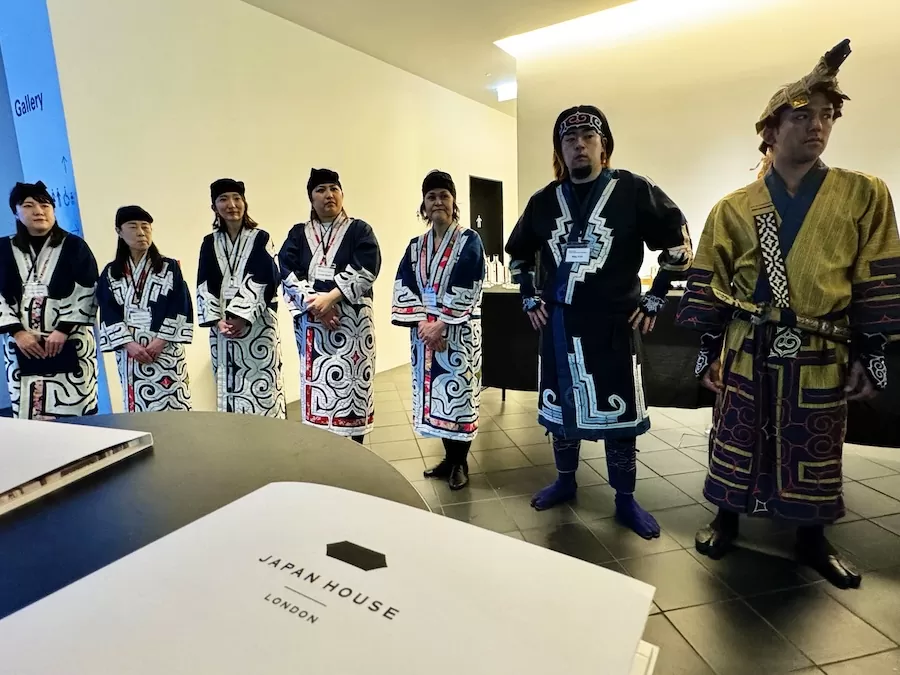
Meet Japan’s indigenous people, the Ainu, who were the earliest settlers of Japan’s northernmost island, Hokkaido and their descendants still live there! Japan House London’s new exhibition gives you a rare opportunity to experience first-hand how Ainu people are living today.
The Ainu were the earliest settles of Hokkaido, the northernmost island of Japan. Their culture is considered to have been created between the 9th and the 13th centuries.
The Ainu people live in the Saru River basin in South Hokkaido, and they were officially recognised as indigenous people in Japan in June 2008. The Ainu population was 13,118 in 2017 and 210 in the rest of Japan in 2011 (Source: IWGIA). In the second half of the 20th century many Ainu moved to Japan’s urban centres, so experts assume that the actual Ainu population is much higher.
The Ainu culture has a distinctive language, traditions, belief, and clothing that are unrelated to the Japanese.
Ainu Stories: Contemporary Lives by the Saru River
Photo: Urban Adventurer
The exhibition offers a rare first-hand opportunity for visitors to experience Ainu culture as it looks like today. Unlike other exhibitions, this exhibition focuses on the present instead of the past.
Visitors will see original woodcarvings made by members of the Ainu society, robes they wear in special occasions, a manga series (‘Golden Kamuy’ and it has a very popular anime series, too), inspired by the Ainu and much more.
The exhibition is free to visit from 16 November 2023 – 21 April 2024 and there will be talks, demonstrations, and workshops, such as cuisine, arts & crafts, dance and more.
Most of the workshops and demonstrations are free, just check “what’s on” and book your session on Japan House London’s website.
The exhibition is divided into multiple sections, from textile, to woodcarving to food and language. Visitors can learn more about Ainu culture and traditions through interviews and short clips shown on screens.
Woodcarving
Photo: Urban Adventurer
Woodcarving plays an important role in Ainu people’s lives. ‘Nibutani Ita’ are carved wooded plates, decorated with elaborated patters ‘morew’ (gentle spirals), ‘ayus’ (thorns), ‘sik’ (eye shapes) and ‘ram-ram’ (fish scales).
Traditional woodcarving techniques and patterns are passed from generation to generation. In the exhibition, you will see wooden plates carved by younger woodcarvers and their masters.
Textile and Clothing
Photo: Urban Adventurer
Today there are only a handful of weavers in Nibutani who produce ‘attus’, a fabric woven from the inner bark fibres of elm and linden trees. Because of its durability, breathability, and water resistance, ‘attus’ has been a very popular form of workwear for fishermen.
The Ainu wear robe or ‘amip’ made from ‘attus’ for ceremonies and special occasions. These robes are richly decorated with embroidery and each region has its own unique style.
Dance and Songs
Photo: Urban Adventurer
Singing and dancing are important elements of Ainu life. Each region has its own characteristics. Biratori region dances, for example often refer to birds.
Singing and dancing are vital parts of the Ainu’s everyday life to maintain and express their culture and is carried out for enjoyment rather than entertaining others.
Food
Photo: Urban Adventurer
The Ainu have extensive knowledge of plants and how to cook them as well as how to use them as medicine. Most of the ingredients of Ainu dishes come from the wild. They use wild vegetables that they season with fish oil and animal fat.
It’s a fundamental etiquette in Ainu culture to only take what you need. The Ainu are determined to maintain a sustainable relationship with the environment and ensure they leave the roots untouched when harvesting mountain vegetables.
Their traditional soups are ‘ohaw’ and ‘rur’ that contain wild onions, salmon, and deer or bear meat.
Language
Photo: Urban Adventurer
Ainu language is distinct from Japanese, however, there are some aspects of word order that are similar. Ainu language is purely verbal. Stories and legends have been passed orally from generation to generation. It is, however, now transcribed using Latin alphabet and katakana.
UNESCO listed Ainu language as endangered in 2009.
Evidence of the Ainu language can be found in names of places throughout Hokkaido, such as Poroshiri, the highest mountain in the Hidaka Mountains. The name of the mountain is derived from the words of ‘poro’ (large) and ‘sir’ (land).
Some Japanese words also have Ainu origins. For example, ‘rakko’ (sea otter), ‘konbu’ (kelp seaweed) and ‘tanakai’ (reindeer).
Ainu Baby Born in London
The Japan-British Exhibition was held at the Great White City in London between May and October in 1910.
The exhibition celebrated the ongoing Anglo-Japanese Alliance promoting Japan as a ‘modern civilised’nation and was visited by over 8 million (!) people.
Part of the exhibition was ‘Ainu Home’, which was basically an Ainu village where 10 Ainu people helped showcasing the village life. However, 10 Ainu arrived in London, and 11 returned to Hokkaido because a baby was born during the time of the exhibition.
The baby was given the name of Kaizawa Hidehiro, written in Japanese uses two characters which can mean ‘Britain’ and ‘exhibition’. He was the first Ainu baby born in Europe.
All performers at the ‘Ainu Stories: Contemporary Lives by the Saru River’ at Japan House London are members of the Ainu community in Biratori. They help maintain their cultural heritage through skills and knowledge, including dance, sing, woodcarving, language, and cuisine: Kimura Hiromi, Harada Rino (one member of singing duo Ankes), Monbetsu Atsushi, Hiramura Daiki, Kimura Manami, Sasaki Tomoyo, Yamada Sakurako, Hiramura Harumi, Yūki Riku, and Nishiyama Ryō.
Woodcarvings, robes, and artworks are available to purchase in Japan House London’s shop upstairs.
If you’re interested in traveling to Japan, make sure you visit ‘Travel Zone’ staffed by Japan National Tourism Organisation offering free travel advice and leaflets.
Ready for your next adventure? If you’re looking for kids activity related to Japan, Young V&A Museum’s very first exhibition: ‘Japan: Myths to Manga’ opened this October.
Inspired by an annual exhibition under the same name in Tokyo and curated by the same curators, Hiro Sugiyama and Takahashi Kintarō, ‘WAVE’exhibition displays artworks from Japan’s most significant graphic artists.
Many of the artists are heavily influenced by anime and manga and well-known for their iconic designs and collaborations with the most famous brands.
WAVE: Currents in Japanese Graphic Arts represents a selection of 60 well-known and emerging Japanese artists.
The artworks displayed in the exhibition include elements of pop art, surrealism, and illustration, representing a variety of styles and artistic backgrounds from artists from their early twenties to their late eighties.
Inspired by Anime/Manga
Kageyama Tōru: Sharaku
Photo: Urban Adventurer
Among the artworks on display, you’ll find many artists heavily inspired by anime and manga, such as Kageyama Tōru who is best known for his book cover designs in Japan. Besides anime and manga his main influence are European and Chinese landscapes, as well as 18th century Japan’s ukiyo-e woodblock print tradition.
Hayakawa Motohiro: X Planet Battles
Photo: Urban Adventurer
Hayakawa Motohiro’s bold and colourful paintings represent vintage sci-fi heroes, aliens and robots in psychedelic, dreamlike landscapes. His illustrations and characters are heavily engaging with comic-style battle scenes.
Terada Katsuya (Untitled)
Photo: Urban Adventurer
Terada Katsuya is an anime and manga artist who designed characters for video games, Japanese animated films and series and worked on some of the most famous American comics: Iron Man and Hellboy.
Artist Oki-chu’s unmissable style is called ‘automatism’ and he is known for his elaborated pen and pencil drawings. His primary influences are the world of anime and manga and video games. This influence is tangible in his artworks.
Japan’s Leading Artists and Illustrators
Tanaami Keiichi: Shōnen Tiger 02, Shonen Oja, Shōnen Tiger 01
Photo: Urban Adventurer
Visitors have the privilege to see original artworks from Japan’s leading illustrators and commercial illustrators.
Tanaami Keiichi is one of Japan’s leading pop artists. He has worked as a graphic designer since 1960s. He is an illustrator, and video artist, showing his artwork in numerous exhibitions in Japan and abroad.
Maki Kahori: Meditative Flower
Photo: Urban Adventurer
Maki Kahori is best known for her incredibly detailed flowers and plants motifs. She has collaborated with the biggest brands, such as Apple and Adobe Systems.
Uno Akira is one of Japan’s leading artists and illustrators, best known for his timeless characters and fantasy scenes.
Yamaguchi Harumi is a leading name in Japanese advertising. She is known for her female character, ‘Harumi Gals’. A glamours, strong, confident, and active female figure free from traditional feminine roles.
Hanai Yusuke’s name might be familiar to many of us by his collaboration with Vans. Hanai is influenced by beatnik, hippie and surf culture. In his artworks, he depicts an adventurous, wanderlust lifestyle.
Ichijō Hikaru: Twins
Photo: Urban Adventurer
Ichijō Hikaru, influenced by print technology and designs bold images of athletic female figures. She has collaborated with Nike and Calbee.
Book cover design by tupera tupera
Photo: Urban Adventurer
Tupera Tupera, a designer team of husband and wife, have created some of Japan’s most popular children’s books, including ‘Shirokuma no pantsu’ (Polar Bear’s Underpants).
The book is available to purchase in the shop of Japan House.
‘Heta-Uma’ – Ugly but Beautiful
Yumura Teruhiko: GONZO’S Underground Mix Vol.7
Photo: Urban Adventurer
‘Heta-Uma’ movement (translated as ‘bad but good’) also represents itself at ‘WAVE’. ‘Heta-Uma’ movement emerged in the 1970s thanks to a manga magazine, called GARO. ‘Heta-Uma’ challenges our perspective of what is ‘ugly’ and what is ‘beautiful’. It asks the question: can something that is considered to be ugly, be beautiful at the same time?
Make Your Own WAVE Badge Workshop
Photo: Urban Adventurer
A fun badge-making workshop is connected to the exhibition where you can choose from a number of ready-made badge designs based on the 60 different artworks featured in the exhibition or use your creativity and create your own.
‘Heta-Uma’ Colour-Changing Cocktail inspired by WAVE Exhibition at AKIRA Restaurant
Photo: Urban Adventurer
Make sure you visit AKIRA Restaurant upstairs for amazing bento boxes and try the new exhibition-inspired colour-changing cocktail: ‘Heta-Uma’
‘Heta-Uma’ Cocktail
Orange-infused shōchū, sake, star anise, and blue curaçao are shaken over ice, before being poured into glass filled with ice and lined with grenadine. Next, lichee and yuzu juice added to the blend to form a white cloud in your glass. Finally, the cocktail is garnished with a raspberry soaked in absinthe and set light in front of your eyes.
Mix the cocktail well to see it changes colour from dreamy blue to vivid orange.
Bento Box at AKIRA Restaurant – Japan House
Photo: Urban Adventurer
TIP: From Tue – Fri AKIRA Restaurant offers £10 OFF* their signature bento boxes at lunchtime. *Online booking only.
There’s always something new and exciting to explore at Japan House. Now there are two exhibitions running parallelly: Tokyo Light Odyssey, which is a 360o immersive motion graphic exhibition, transporting visitors into a vibrant and colourful vision of a pulsing sleepless city.
Woodland Shade is an interactive exhibition of traditional Japanese wooden dolls, called: kokeshi dolls and otaka poppo toys.
The exhibition gives us a glimpse into to old local craft of Tohoku region of northern Japan. Having been recreated by digital technology, these wooden dolls and toys allow visitors to discover more about their history throughout fun interactive digital experiences.
The two exhibitions are FREE and open until 22 March.
Tokyo Light Odyssey
The 5 minutes 25 seconds motion graphic experience transports visitors into Tokyo’s vivid night lights.
Visitors ride through millions of illuminating windows, fly among glowing skyscrapers, run through an underground, sprint with the traffic in a tunnel and wonder around mini planets of lights and sleepy local homes.
Woodland Shade
Kokeshi dolls were traditional toys with simple painted decoration. Some of these decorations were made for healthy growth of children as kokeshi dolls were believed to have spiritual power and can protect children from the evil and from harm. Today kokesi dolls are sold as souvenirs.
130 faces of inhabitants from Yamagata Prefecture are projected to undecorated kokeshi dolls.
You can have your face scanned by a computer and the simplified version of your portrait will appear on one of the wooden dolls displayed. (I’m the second one from the left-hand side)
Visitors can create their own virtual wooden toy while learn more interesting facts about them.
Ready for your next adventure? Follow me on Instagram and get inspired.
We use cookies on our website to give you the most relevant experience by remembering your preferences and repeat visits. By clicking “Accept”, you consent to the use of ALL the cookies.
This website uses cookies to improve your experience while you navigate through the website. Out of these cookies, the cookies that are categorized as necessary are stored on your browser as they are essential for the working of basic functionalities of the website. We also use third-party cookies that help us analyze and understand how you use this website. These cookies will be stored in your browser only with your consent. You also have the option to opt-out of these cookies. But opting out of some of these cookies may have an effect on your browsing experience.
Necessary cookies are absolutely essential for the website to function properly. This category only includes cookies that ensures basic functionalities and security features of the website. These cookies do not store any personal information.
Any cookies that may not be particularly necessary for the website to function and is used specifically to collect user personal data via analytics, ads, other embedded contents are termed as non-necessary cookies. It is mandatory to procure user consent prior to running these cookies on your website.