Being promoted by such A-listers like Arnold Schwarzenegger, Sylvester Stallone, Bruce Willis, Demi Moore and Whoopi Goldberg, Planet Hollywood is a world-famous dining and entertaining spot in the heart of London.
Photo: Urban Adventurer
Since located in West-End theatre district, they have a special “Pre-Theatre Menu” available when you book it through an on-line theatre and meal deal.
The Ambiance
A life-sized Terminator statue welcomes you on your arrival.
Photo: Urban Adventurer
The walls are decorated with props and costumes from famous blockbusters such as Star Wars or James Bond.
The venue is airy and comfortable, not overcrowded with too many tables and chairs.
Photo: Urban Adventurer
Large screens show interviews and trailers of upcoming movies to keep you entertained while sipping your movie themed cocktail.
Don’t forget to head up the stairs to see the wall of handprints and signatures. Place your hand over the handprints of such legends like Silvester Stallone or George Clooney and have fun with comparing the size of your hands.
Photo: Urban Adventurer
Private Hire
There are three themed rooms to be private hired.
Bond Room
Photo: Urban Adventurer
The 007 themed room is decorated with impressive props from famous Bond movies, such as Goldeneye, Live and Let Die and Moonraker.
Union Jack carpet, kaleidoscopic walls with famous hands created exclusively for Planet Hollywood London. The British Room plays tribute to the legends of British cinema, and TV legend memorabilia from Love Actually and Chariots of Fire just to name a few.
Swimming pool design carpet and diving board tables. This is the Cabanas Beach Bar themed room from where you can enjoy perfect view across the entire venue.
The Food
I tried Teriyaki Grilled Salmon with white rice and vegetables. The presentation was beautiful, the salmon was super tasty, and the vegetables were fresh and crunchy.
Photo: Urban Adventurer
My dessert was a White Chocolate Bread Pudding. This dessert was served hot with mouth-watering vanilla ice cream, bourbon sauce and whipped cream. Yummy!
Photo: Urban Adventurer
I couldn’t resist the legendary Chocolate Comet Supernova Shake and regret nothing. It looked just like in those photos on social media and was just as delicious as it looked.
Photo: Urban Adventurer
The waitress who served me was super friendly and the service was quick and efficient.
Had a great time there. Thank you, Planet Hollywood! I’ll be back.
If you don’t look carefully, you could easily miss London’s smallest attractions. Did you know that the world’s smallest bar room is part of a tiny pub in Hammersmith? Do you know the heart-breaking story behind London’s smallest statue?
Here are some of London’s most fascinating tiny attractions and the story behind them.
London’s Smallest Statue – The Two Mice Statue
Photo: Urban Adventurer
London’s smallest statue is located on the corner building of Philpot Lane Eastcheap, EC3.
Keep your eyes peeled when you’re there because the statue is high above your head and only a couple of inches long.
The tiny statue pictures two mice fighting over a piece of cheese and has been on the building’s wall since the building was built in 1862.
The story behind the statue says that when the Monument of Great Fire was being built, two men working on the construction site sat on the top of the monument for lunch break. The two men were friends, but the trouble started when one of them realised his cheese sandwich was missing and accused his friend of steeling it.
They started a fight over the missing cheese sandwich and during the fight both of the men fell from the 62-metre-high monument and died. Later it turned out that the cheese sandwich had been stolen by mice living on the construction site.
To commemorate the men, London’s tiniest statue was built and is still there for us to look up and remember the two men died because of a sandwich.
London’s smallest bar room is located in 19 Upper Mall, Hammersmith, W6 9TA within The Dove Pub, and even went into the Guinness World Records. It measures 4 feet 2 inches by 7 feet 10 inches (1.27 metres by 2.39 metres).
This is not the only thing The Dove is worth to visit, though. The pub started as a public house in the 17th century, and was regularly being visited by famous writers, poets, politicians and even kings, such as poet James Thomson, who composed the famous ‘Rule, Britannia!’. Charles II often visited The Dove too with his mistress, Nell Gwynne.
In the most recent years, The Dove hosted famous actors, writers and politicians within its walls.
In the bar room, you can also see a brass plaque that marks the height the waters reached in the great flood of 1928.
The Smallest Single Pub – The Rake
Photo: Urban Adventurer
The Rake is London’s smallest single pub. It’s located just behind Borough Market, SE1 and it has the largest selection of beer from all over the world.
The Smallest Church – St. Ethelburga-the-Virgin
Photo: Urban Adventurer
St. Etherlburga-the-Virgin is located in Bishopgate, EC2, and it’s one of the few surviving medieval churches in London. It measures 56 feet by 30 feet (17 metres by 9.1 metres).
The foundation of the church is unknown, but it is believed that it dates back at least to the 13th century.
During the WWII 70% of the church was destroyed. After the war ended the church was proposed to be demolished but it caused a huge public outcry. Eventually, the church was rebuilt to its original plan, and is still operating today.
The tiny police station was built in 1926 and it’s inside an ornamental light fitting. After the light fitting being emptied, narrow windows were installed to allow a 360 degrees view to the area.
Even a direct phone line was installed to the Scotland Yard in case help needed. Whenever the police officer picked up the phone the ornamental light on the top started to flash to alert nearby officers for near trouble.
The tiny police station was able to accommodate a single police officer or two prisoners at a time.
Today it is no longer in use to its original purpose. It is a broom cupboard of Westminster Council cleaners.
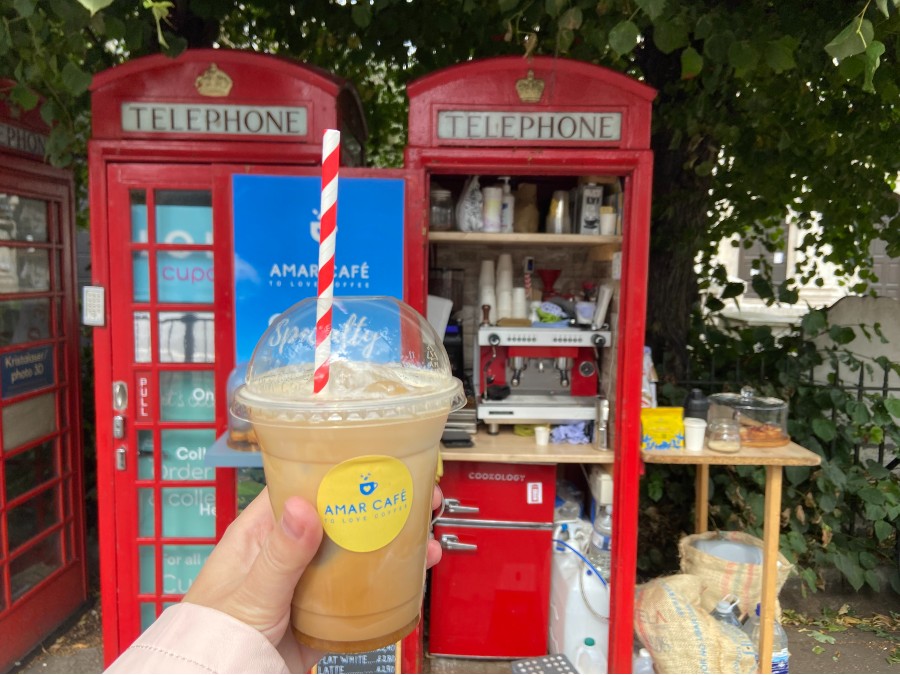
The Smallest Café – Amar Café
Photo: Urban Adventurer
London’s tiniest café is called ‘Amar Café’ and it is operating in a red telephone booth. Amar Café has three shops: one in Greenwich (Greenwich High Rd, SE10 8NA), one in Chiswick (Corner at, Chiswick High Rd, W4 5TF) and one in Stratford Upon Avon, next to Shakespeare Theatre (CV37 6EF)
Photo: Urban Adventurer
As they say on their website, they do not choose obvious locations within London. Instead, they choose symbols of the country and bring them to life.
The Smallest Library
Photo: Urban Adventurer
Situated on the corner of Loampit Hill and Tyrwhitt Road, in Lewisham, London’s smallest public library is operating in an iconic red telephone booth.
The tiny library has an impressive selection of books, and borrowers are expected to either replace or bring back books they take to be able to keep up a good stock level.
The telephone box library is open 24/7. Feel free to visit it on any day any time.
The Smallest ‘Listed’ Building – The Ostler’s Hut
Photo: Urban Adventurer
Hidden away in Lincoln’s Inn, WC2A 3TL, The Ostler’s Hut looks like a house of fairies and hobgoblins.
In fact, the hut was built in 1860 and it accommodated a horseman to take care of law students’ horses while they worked.
No sooner, however, when motorcars replaced horses, the horseman’s job no longer needed. As a result, The Ostler’s Hut closed and never used again.
The Skinniest House
Photo: Google Street View
Believe it or not, London’s skinniest house is just 5 feet 5 inch (1.65 metre) wide. The house is in Shepherd’s Bush between two shops in Goldhawk Road, W12 8HD.
The house was home to a fashion photographer, Juergen Teller in the 1990s. In 2006 Simon Woods, the Pride and Prejudice actor bought the house. The property was last sold in 2009 and it went for sale again last September.
The Narrowest House – Thin House
Photo: Urban Adventurer
This insanely narrow house is known as ‘Thin House’ among Londoners. It’s located in 5 Thurloe Square, South Kensington, SW7 2TA, and is actually a triangle. What we see in this perspective is the building’s narrowest end, which is as narrow as 6 feet (1.8 metre). The widest end is 34 feet (10.3 metres).
Many of the houses on Thurloe Square were designed by London architect George Basevi. Basevi was one of the students of the famous neo-classical architect Sir John Soane.
That Sir John Soane whose extraordinary collection of antiquities, furniture, sculptures, architectural models and drawings, and paintings is under display in Soane Museum (13 Lincoln’s Inn Fields, WC2A 3BP) in London, and free to visit. (Did you know that some scenes of Transformers 5 movie were filmed here?)
In the late 19th century Kensington and Chelsea were an artist hub, so lots of famous artists lived or had studios in the area.
The Smallest House
Photo: Urban Adventurer
The title of the smallest house in London goes to this tiny little one at 10 Hyde Park Place, W2. This house was built in 1805 and its purpose was probably to seal an alley which led to St. George’s churchyard to keep grave robbers away.
The house measures 3 feet (95 cm) across and it contained 2 rooms (32 feet by 4 feet, 9.7 metres by 1.2 metre) connected by a ladder.
The Shortest Street – Kirk Street
With its 50 feet (15 metres) length, Kirk Street, WC1 is London’s shortest street. It has only one address.
The Narrowest Alley – Brydges Place
Photo: Urban Adventurer
London’s narrowest alley – Brydges Place, WC2 – connects St. Martin’s Lane and Bedfordbury in Covent Garden. The alley is as narrow as 15 inches (38 cm).
The Smallest Square – Pickering Place
Photo: Urban Adventurer
Pickering Place – off St. James Street, SW1 – is not only the smallest square in London, but also the last place seen a duel with swords.
In the 18th century Pickering Place was notorious for gambling dens, duels, and bear baiting.
Believe it or not, Pickering Place was once home to Texan Republic’s embassy (until it joined the United States in 1845).
What is more, you can also find King Henry’s old barn, which is just opposite to the passageway.
Christmas lights in London are magical every year. Normally crowds travel to see the most beautiful and most popular streets and spots, such as Covent Garden, Oxford Street, Regents Street and Hamleys Toy Store to participate in the switch-on events.
Photo: Urban Adventurer
This year, however, many have been forced to change their traditions. Well, let’s see the bright side of this: the streets are far not that crowdy as usual this time of the year allowing you taking beautiful photos without being forced to elbowing your way to the best spots.
Luckily, pandemic or not pandemic, Christmas lights are just as exuberant and beautiful as usual.
Let’s see some of the most popular spots.
Leadenhall Market
Leadenhall Market’s history dates back to the 14th century. Originally it was a meat, poultry and game market and was situated in the centre of Roman London. Today it gives home to elegant retailers, restaurants, cafes and wine bars.
Leadenhall Market is famous for being used as Diagon Alley in Harry Potter and the Philosopher’s Stone. What is more, the entrance to the famous fictional pub, the Leaky Cauldron is located there. In real life, it’s an optician on Bull’s Head Passage in Leadenhall Market.
St Katharine Docks
St Katharine Docks welcomes vessels from all over the world since the 10th century. Today it’s a lovely hidden gem that gives home to cozy restaurants and the famous Dickens Inn.
During the festive period St Katharine Docks looks like a scene from a Dickens novel from the Victorian era. Perfect place to get the festive feeling.
More London
The buzzing More London is famous for its lovely outdoor Christmas market. During December the air is always filled with the sweet smell of freshly roasted nuts. Unfortunately, this year’s Christmas market has been cancelled due to pandemic.
The Tower of London
Sadly, the ice rink, which is a tradition, is not operating this year due to pandemic.
However, The Tower of London still gives us tons of opportunities for Christmas shopping and a lovely view to the Tower Bridge, River Thames and The Shard light show.
You can admire the view from one of the cozy igloos of Coppa Club. Perfect for an intimate socially distanced family dinner.
The Shard Lights
This year The Shard lights are specially designed to show gratitude to NSH staff, and all keyworkers and volunteers who have worked tirelessly to keep us safe from Coronavirus pandemic.
From 11th December The Shard light will feature the traditional colours of Christmas until the early hours of New Year’s Day.
Covent Garden
Covent Garden’s centrepiece is its hand-picked Christmas tree every year. This year the Christmas tree is 60 feet tall and it’s illuminated by 115,000 lights.
The tree needed 60 workers and 300 working hours to be festively decorated.
Photo: Urban Adventurer
This Christmas tree is is not the only one at Covent Garden. There is a mini Christmas tree forest just at the entrance of Covent Garden. Each tree is bedecked uniquely by iconic brands and institutions, such as Royal Opera House.
The Strand
Photo: Urban Adventurer
From Trafalgar Square to King’s College, The Strand is dressed with twinkling snowflakes, icicles and stars all the way long.
Leicester Square
Although, ‘Christmas in Leicester Square 2020’ is cancelled due to pandemic, there are still plenty to see and do there.
Photo: Urban Adventurer
‘Scenes in the Square’ bronze sculptures are still on display under the festive lights, celebrating the home of film, and immortalise classic characters. Wonder Woman, Paddington Bear, Mr Bean, Mary Poppins, Bugs Bunny and more. Plus, a Harry Potter sculpture has been added to the repertoire.
Regent Street
‘The Spirit of Christmas ‘ installation has returned to Regent Street. To support sustainable display, the lights are switched on for evenings only.
Carnaby Street
Photo: Urban Adventurer
This year Carnaby Street Christmas light installation is in partnership with Choose Love charity to pay tribute to the strength and courage of Londoners and the whole UK.
Pink and purple lightboxes display positive words all the length of Carnaby Street hoping to bring smile on peoples’ faces during these hard times filled with uncertainty.
Hamleys
Britain’s most famous and beloved toy store transformed their Christmas windows into a magical world. Harry Potter themed display brings the magic to us this year.
Oxford Street
This year Oxford Street Christmas lights are dedicated to silent heroes. Anyone can nominate their hero by filling in thisform on Oxford Street’s official website for a chance to see their name sparkle in the Christmas lights. Plus, the winner heroes will receive a £500 Oxford Street gift card to treat themselves. Winners announced each week.
Use hashtag #our2020heroes to be featured on Instagram
South Molton Street
Photo: Urban Adventurer
South Molton Street, just like last year, is illuminated with beautiful blue arches and blue Christmas trees on each end of the street. Why not pick up a Winter warmer at one of the lovely cafés while admiring the magical lights?
Annabel’s
Annabel’s is an elegant private club in the heart of Mayfair. They traditionally surprise Londoners with the most magical Christmas installation. This year they transformed the building into a giant nutcracker stage.
Hedonism Wines
Festive feeling guaranteed after visiting Hedonism Wines on St Davies Street, Mayfair.
Fortnum & Mason
Now it’s a tradition that the impressive six-floor building is transformed into an Advent Calendar for the festive period every year.
Burlington Arcade
One of London’s favourite shopping arcade is not just dressed up festive, but it’s as immersive as possible too.
Photo: Urban Adventurer
Make sure to dress up with matching clothes and take some lovely photos while sitting on the festive swing or pose with one of the glamourous Christmas trees.
Piccadilly Arcade
Twinkling lights and crystals. Piccadilly Arcade is just opposite Burlington Arcade.
Piccadilly Arcade is the place where Mayfair meets St James’. The perfect place to start your Christmas shopping.
Bond Street
Their peacock inspired light display is just as unique as Bond Street itself. Tiffani, Cartier and Sella McCartney, just to name a few famous brands inhabited at Bond Street and give us that lavish Christmas feeling.
The Ritz Hotel
Photo: Urban Adventurer
Elegant and classy. That’s how we could summarise The Ritz Hotel Christmas decoration every year. The Ritz London really knows what a stylish Christmas looks like.
Tree of Hope at St Pancras
Tree of Hope has been set by London’s pinkest Insagrammable café, EL&N Café. The pink Christmas tree with the carousel horses around it refers to the difficult period of time we’ve all been experiencing this year, and the hope that gives us strength to get over the difficulties.
Photo: Urban Adventurer
You can buy matching pink chocolate Christmas tree dessert in EL&N Café located right next to the Christmas tree.
“Monsieur is going to leave home?” “Yes,” returned Phileas Fogg. “We are going round the world.”
― Jules Verne, Around the World in 80 Days
Being an Urban Adventurer, I’m constantly on the hunt for the extraordinary, the jaw-dropping and the eccentric in London.
During my adventures I’ve visited the pinkest, the quirkiest, the weirdest and the smallest bars and cafés. Now I’ve found, and this is without doubt, the most adventurous bar series in town.
Mr Fogg’s have 6 Insta-worthy adventurous bars, each with different themes, inspired by Phileas Fogg’s incredible journey around the world.
The Inspiration
Photo: Urban Adventurer
The concept behind Mr Fogg’s bars is Jules Verne’s famous novel, Around the World in 80 Days.
Each bar takes us to the theatrical world of Mr Fogg in the Victorian era, reflecting a stop of the adventurer’s journey.
The bars are stuffed with things Mr Fogg might collect during his journey. Maps and charts, flags and stuffed animals, old bicycles, bird cages, antique clocks and telescopes.
It’s not just the decoration that reflect Mr Fogg’s Victorian world. Each Mr Fogg’s venue offers different cocktail menu tailored to the bar’s specific theme helping you stepping into the novel’s pages and completely immerse into the fantasy novel.
Mr Fogg’s Residence
“We are going round the world.”
Photo: Urban Adventurer
Mr Fogg’s Residence showcases a vast collection of rare artifacts and antiques he collected during his journeys in the farthest corners of the globe. Each item has an interesting and adventurous background and story about how Mr Fogg obtained it.
Even the ceiling is loaded with treasures such as old bicycles, bird cages once gave home to rare birds, paintings and a life size hot air balloon.
Mr Fogg’s Residence is really beyond the law and physics.
Adventurous Fact
In 2017, Mr Fogg’s sent the first bottled cocktail to the space. The bottle was sent to 27km high above the surface and was exposed to temperatures as low as -57 Celsius. Upon its arrival back to Earth, the cocktail flavoured a limited-edition drink in Mr Fogg’s Residence. The cocktail was named as ‘From The Earth to The Stars’ after another famous novel from Jules Verne. Only 50 of out-of-this-world cocktail creation was available, each costing £25. The lucky drinkers got a certificate with their order, announcing that they’d drunk something supernal. And how the celestial cocktail tasted? Well, imagine a perfect blend of superterrestrial bitter, campari, gin, lavender, grapefruit peels, orange peel, lemon peel, fresh chamomile and angelica root. Mmmmm…exquisite.
Instead of removing furniture, they have implemented social distancing by sitting Victorian-style mannequins to their tables. The idea helps maintaining the safe social distance while adding to the fun atmosphere instead of taking from it
Mr Fogg’s Tavern
“But what then? What had he really gained by all this trouble? What had he brought back from this long and weary journey? Nothing, say you? Perhaps so;…Truly, would you not for less than that go around the world?”
Photo: Urban Adventurer
Mr Fogg’s Tavern lies in the heart of London’s famous theatre district and transports you to a traditional Victorian pub. The waiters and waitresses are dressed and act as if they were from the Victorian era and to enhance the experience, the ceiling is enwrapped with eccentric memorabilia from all over the globe.
Robust wooden tables and benches are waiting for the tired travellers to quench their thirst with a pint of draught beer or one of the Landlady Fanny McGee’s famous juicy punches.
Adventurous Fact
Mr Fogg’s Tavern is not just a tavern. It’s a heaven for art and theatre lovers
Mr Fogg’s Gin Parlour
“Phileas Fogg took a chair, and sat down near the fireplace, opposite Aouda. No emotion was visible on his face. Fogg returned was exactly the Fogg who had gone away; there was the same calm, the same impassibility.”
Photo: Urban Adventurer
Mr Fogg’s Gin Parlour is a hidden hunter-themed room upstairs within Mr Fogg’s Tavern. The Gin Parlour is a tiny yet cozy hideaway with vintage upholstered seats, a fireplace, chinoiserie wallpaper and an exquisite collection of gins, tonics and botanicals.
Photo: Urban Adventurer
I loved the idea of Victorian hats being left all around the bar waiting for visitors to try them on and take photos while wearing them.
The bar is really a hidden gem and the cocktails are beautifully presented and delicious.
Photo: Urban Adventurer
Adventurous Facts
The Gin Parlour has over 230 gins to choose from, some of which are rare from different corners of the globe
The Gin Parlour runs ‘Gin Safari’ experience where you can not only taste Gins from different parts the world, but also learn all the ins and outs of Gin, botanicals and tonics. Plus, the safari includes tasty treats, such as cheese platter, platter of cured meats and olives (vegan options also available)
Mr Fogg’s House of Botanicals
“I see that it is by no means useless to travel, if a man wants to see something new”
House of Botanicals is an exotic tropical paradise. Lots of greenery everywhere and a beautiful, dreamy floral spiral staircase.
The venue really looks like a botanical garden and the cocktails had carefully been designed around the theme of the venue. A perfect escape from the busy city life.
Photo: Urban Adventurer
We ordered a ‘Miss North’s Pitcher Plant’ and a ‘Charge of the Light Brigade’ to start. ‘Miss North’s Pitcher Plant’ stylishly came in an oh-so-Instagrammable pitcher plant shaped glass (Wow!).
Photo: Urban Adventurer
‘Charge of the Light Brigade’ came in a cool silver goblet and was decorated beautifully. Both cocktails were amazing. Their tastes were in perfect balance.
Photo: Urban Adventurer
The second round was a ‘Kooh-I-Noor’ and ‘An Unexpected Beginning’. Both the presentation and the taste absolutely fit the venue’s unique atmosphere.
Photo: Urban Adventurer
The staff was the loveliest we could imagine. The bartenders even posed me for a photo.
Unfortunately, I couldn’t take photos upstairs because it was full, and due to Coronavirus, nobody was allowed to go upstairs unless their booking was for there.
It’s understandable in the current situation. Next time 🙂
Adventurous Fact
House of Botanicals’ staff wore beekeeping suites to provide a quirky PPE solution when re-opening their suite after the first lockdown. Learn more about Mr Fogg’s nailed social distancing in thier venues here
Mr Fogg’s Society of Exploration
“It’s really useful to travel, if you want to see new things.”
Photo: Urban Adventurer
Society of Exploration is just a stone-throw away from the bustling Charing Cross station, and it’s a sanctuary for the likeminded and the curious.
The bar celebrates the revolution of innovation, travel and Victorian mechanics. The venue is split into three extraordinary rooms:
The Map Room, which is an impressive collection of antique maps, travel books and other souvenir from the farthest corners of the planet.
The life-sized Victorian train carriage that provides an intimate place for banquets and other events. Its rustic leather seating, antique brass lamps and large windows overlooking the bar provide the perfect place for an intimate gathering.
The bar area’s decoration is rich and eccentric. The walls are covered with wood panels, providing a backdrop for a collection of antique barometers, oil paintings, trophies and other artefacts.
Adventurous Facts
In 2019 Mr Fogg’s Society of Exploration launched a viral video campaign. It was advertising the most adventurous dream job one can imagine.
The successful applicants would travel the globe in 80 days (or less) to collect the most unique and diverse ingredients for cocktails while all expenses covered. The video quickly gained media attention worldwide, received more than 10,000 (!) applicants and even the famous actor Ryan Reynolds wanted to apply.
Society of Exploration is home to Mr Fogg’s incomparable Mechanical Mixologist. It’s the world-first automated cocktail making machine, a revolutionary invention making you the finest ice-cold Negroni at the touch of a button.
The machine automatically puts an ice cube into the glass then rotates a wheel of ingredients to mix and pour them into the glass before serving it on a conveyor belt
Mrs Fogg’s Dockside Drinkery & Distillery
“Mr. Fogg … would you like both a relative and a friend? Would you like to have me as your wife?”
Photo: Urban Adventurer
Ahoy sailors, seadogs, pirates and stowaways! No dry throats here. Anchor your boat and have an ice-cold draught beer, a punch or wine in this restless and bustling Victorian-style bar at the East End.
In Mrs Fogg’s Dockside Drinkery & Distillery you’ll feel like you were on an adventure on sea.
Photo: Urban Adventurer
Once boarded on the ship you will either be seated in the bar area upstairs or the life-sized Rangoon Steamer, equipped its very own bar, providing a VIP travelling experience.
Below deck is where the crew rest and stowaways hide. It’s a richly decorated speakeasy style bar.
Photo: Urban Adventurer
In the Engine Room you can sit within chopper pipes and dials and switches.
Dockside Drinkery & Distillery offers two course brunch, two course brunch with free-flowing pink prosecco, Mrs Fogg’s Pink Gin Cruise or Gin Adventure. Cheers!
Adventurous Fact
You can witness a full functioning distillery in the Engine Room
The staff is dressed like ship crew
Ready for your next adventure? Why not visit the elegant Churchill Bar and Terrace? Did you know that the Churchill Bar and Terrace have been given the blessing of Churchill’s extended family? The Churchill family also contributed to the bar’s décor.
Museum of Curiosity is definitely the weirdest museum in London and it’s not for everyone. Some return every week while others find it disgusting and never go back.
This museum is anything but standard and ordinary. Viktor Wynd, the owner of the collection, has spent a lifetime travelling the globe from Papua New Guinea to Congo to collect his weird and wonderful collection of oddities.
Another World
A spiral staircase leads the visitors into the basement of the former call centre, Museum of Curiosity has been furnished in. Down there you will find yourself in a weird eccentric world, full of odd creatures, occult cabinets, bottled and conserved animals, spell books, dead mermaids and more.
The museum’s purpose is not to attempt to educate and explain the world by a neat and labelled exhibition. Instead, Museum of Curiosity wants to shock and amaze its visitors and show the odd side of the world through a random collection of rare and priceless marvels.
So What to Expect
Relics of extinct birds, Elvis Presley’s hair, leg bone of an Irish giant, a correct mini representation of Lord Nelson’s coffin, a human scalp from the 18th century, hair of a Titanic survivor, pinned butterflies from the most hidden corners of the globe and much more.
The Bar
Museum of Curiosity opened in 2016. Being voted the ‘Best Bar in all of London’ in 2019, Absinthe Parlour & Cocktail Bar have the UK’s most extensive list of premium quality, traditional absinthes that they pair with their wide range of curious cocktails. This is the only cocktail bar hosting absinthe hour in London.
And how are the cocktails? Weird and untraditional as expected from London’s weirdest museum’s bar. Forget traditions and protocol. The cocktails here are a blend of alchemy, magic and fantasy that takes you beyond the known world to the mystery of undiscovered.
The bar gives home to skeletons, unicorn skulls, animal heads and a stuffed half lioness to share your experience with if you happen to visit the bar alone.
Perfect spot for Halloween.
Read for your next adventure? Would you dare to visit London’s most notorious (and most haunted) execution sites?
From the 16th century to the 19th century serious crimes were often punished with capital punishment. The most common method of execution was hanging on gallows, burn at the stake or beheading.
Kings and queens, smugglers and pirates, debtors and traitors lost their lives, some of them in the most gruesome way over the centuries. Most of the cities had one or more execution places for public executions.
In London, there were many notorious execution scenes, some of which are still in public mind even today. Oliver Cromwell, Guy Fawkes, King Charles I, the famous Scottish patriot Sir William Wallace and the famous pirate, Captain Kidd met their fates at one of these sites.
Tyburn Tree had nothing to do with nature or greenery. Instead, it was one of the most notorious execution scenes in London.
Located on the corner of Marble Arch, a memorial plaque is embedded into the pavement in the middle of the triangle three trees form, symbolising the gallows once stood there.
Photo: Urban Adventurer
The gallows changed over times, but Marble Arch website says, the permanent triangular frame was erected in 1571. These gallows allowed 24 criminals to be hanged at the same time.
Executions were a kind of public show during the 16th, 17th, 18th and 19th centuries. Criminals were often carried on an open cart from Newgate Prison through St Giles in the Fields down to Oxford Street to Tyburn. On their way to the execution site, criminals were often thrown things by people who shouted and jeered.
Photo: Urban Adventurer
Even Shakespeare mentioned Tyburn Tree in Love’s Labour’s Lost: “Thou mak’st the triumviry, the corner-cap of society, The shape of Love’s Tyburn, that hangs up simplicity.”
According to Historic UK on 21 January 1664 the famous diarist, Samuel Pepys noted a full account of going to see the execution of someone he knew, Colonel James Turner. According to Pepys’ notes, there were around twelve to fourteen thousand (!) people there to see the execution.
The last execution at Tyburn was in 1783. A robber, named John Austin had been hanged there before the new place of execution become Newgate Prison.
Photo: Urban Adventurer
Tyburn Convent, which is located nearby and dedicated to the memory of martyrs executed at Tyburn, also features memorials on the outside of the building. In the basement visitors can view relics such as blood-stained linen, hair and even a fingernail from the Catholic martyrs’ executions.
Tower of London and Tower Hill
Photo: Urban Adventurer
Tower of London is thought to be one of the most blood-soaked execution scenes all over in London. In fact, there were very few executions there. The Tower was held to those selected few who were for instance, members of the royal family, including Anne Boleyn or Lady Jane Grey.
Next to the Tower of London, Tower Hill was the site where most of the executions were were taken place. Today there is a memorial garden where the scaffold once stood.
Photo: Urban Adventurer
Photo: Urban Adventurer
Sir Thomas More, who was known for his book, ‘Utopia’ and for refusing to acknowledge King Henry VIII was executed here.
Sir Thomas Wyatt, the famous poet was executed here. Likewise, Thomas Cromwell, chief minister to King Henry VIII.
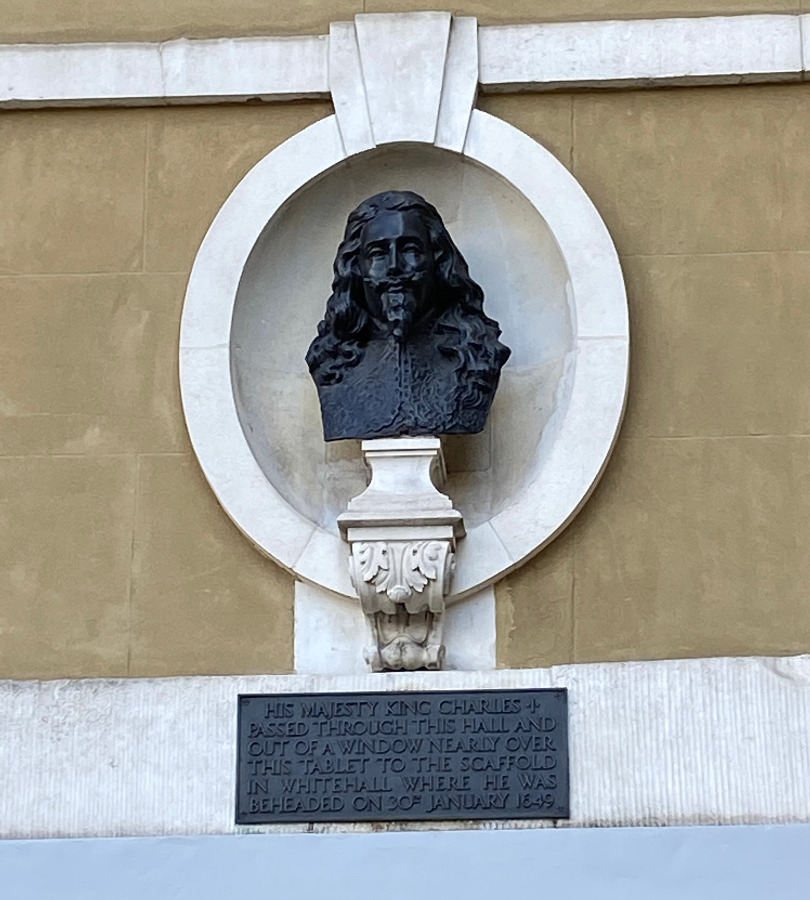
On 30 January 1649 King Charles I was executed outside the Banqueting Hall on Whitehall. King Charles I was charged with high treason and other high crimes against the realm of England and sentenced to death by beheading. He refused the legality of the court because “a king cannot be tried by any superior jurisdiction on earth.”
Photo: Urban Adventurer
You may have noticed that there is a black mark next to number 2 on the clock face nearby Horse Guards. That black mark is not there without reason. The black dot commemorates the execution of King Charles I. According to Britannica King Charles I went bravely to his death. He still clamed, he was a martyr to people.
Photo: Urban Adventurer
Old Place Yard
Photo: Urban Adventurer
What does Old Place Yard have to do with Bon Fire Night we are still celebrating every year? On 5 November 1605, Guy Fawkes along with his conspirators attempted to explode the Parliament and kill King James I.
He and his group transported 36 barrels of gunpowder to the cellar below the Parliament. The plan was to blow up the building on 5th November when King James I opened it. However, the plan failed. The police caught Fawkes with the gunpowder in the cellar on 4th November.
Hearing the news on the following day, people celebrated the king’s escape with fireworks all over the country.
Fawkes was imprisoned to the Tower of London to be tortured before being hanged and drowned at Old Place Yard in front of the Parliament on 31 January 1606. Fawkes body was then cut into four and sent to different parts of the country to put on display for the public to see.
This is the reason Britons celebrate Bonfire Night every year on the 5th November: to mark Fawkes failure on killing King James I.
The Elms Smithfield
Photo: Urban Adventurer
Sir William Wallace was executed here on 23 August 1305. He was one the Scotland’s greatest national heroes. He was the leader of the Scottish resistance forces during the struggle to free Scotland from the English rule.
On 5th August he was captured near Glasgow and taken to London. He was condemned as a traitor and sentenced to death. He went under the most gruesome execution imaginable. He was hung, disembowelled whilst still conscious, beheaded, and quartered. Legends say he remained silent and stoic throughout the ordeal.
Today there is a memorial not far from the scene he was executed. Even today many Sottish people pay their respect by bringing flowers to the memorial.
Photo: Urban Adventurer
The leader of the Scottish War of Independence was famously portrayed by Mel Gibson in the movie ‘Braveheart’ in 1995. The movie won the Academy Awards in the following year in various categories, such as the best picture, the best director and the best costume design.
Apart from Sir William Wallace, many others were killed at The Elms Smithfield. Wat Tyler was cut down by the Mayor of London, John Badby was burned in a barrel and Richard Rouse boiled to death.
The Devil’s Tavern
Photo: Urban Adventurer
During the middle ages until the 18th century there was a regular hunt for pirates and smugglers.
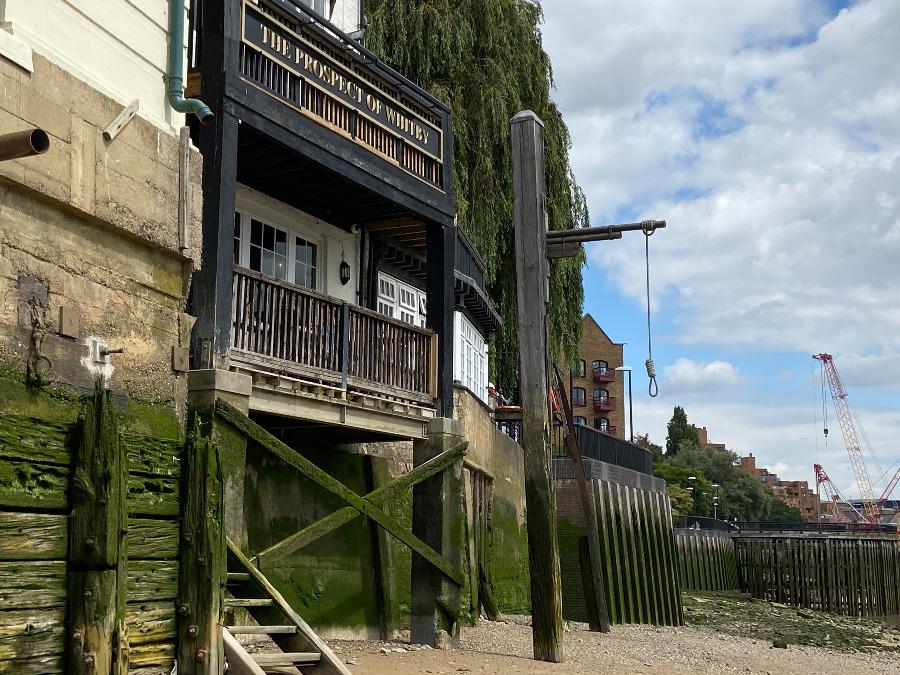
Opened in 1520, The Devil’s Tavern (today The Prospect of Whitby) is the oldest riverside inn in London, and during those old times in history it had a dubious reputation thanks to smugglers, pirates and thieves it attracted.
Located in Wapping, The Devil’s Tavern has seen a lot of pirates being hanged on the riverside.
Photo: urban Adventurer
One of them was Captain William Kidd. The famous pirate was hanged on 23 May 1701. To deter other pirates Captain Kidd was hung in a cage and his body was left there to rot for all to see along the River Themes.
There was a legend that Captain Kidd had buried all his treasure in the Caribbean. After his death generations of treasure hunters travelled to the Caribbean Islands to find his treasure. Although, the treasure has never been discovered, Captain Kidd left a story behind that inspired books, movies and even cartoons.
In the middle ages and during the 18th century a series of gibbet stood at the bank of the River Themes, called Execution Dock. A replica gibbet is still standing behind The Prospect of Whitby.
Photo: Urban Adventurer
Nearby of Captain Kidd’s execution scene a pub preserves the notorious pirate’s name. Captain Kidd pub is designed to look like a ship hulk. Old, framed newspaper articles and letters are hanging on the walls, telling the life and death of one of the most famous pirates in the world.
River Neckinger
Photo: Urban Adventurer
River Neckinger is just a stone-throw away from Tower Bridge and 20-minute walk from The Clink Prison Museum. To get there we have to walk among the walls of Shad Thames that was the largest warehouse complex in London during the 19th century.
Photo: Urban Adventurer
The river’s name is believed to come from the term ‘Devil’s neckcloth’. It’s a slang for the hangman’s noose. A ‘neckercher’ is an old word for a cravat or other covering of the neck.
Until the 18th century, Thames pirates were executed near the mouth of the inlet. The corpses then were placed on display for all to see.
The area was once notoriously filthy and described as “The very capital of cholera” and “The Venice of drains”. Large masses of rotting weed and dead animals were floating in the water which was covered with thick grease.
Charring Cross traditionally marks the centre of London but during the 17th century it was a location of public executions. King Charles II took revenge here against the killers of his father, King Charles I who had been beheaded in 1649 at Banqueting Hall.
Photo: Urban Adventurer
This is how Samuel Pepys the famous diarist recorded a public execution at Charring Cross he had witnessed on 13 October 1660:
“To my Lord’s in the morning, where I met with Captain Cuttance, but my Lord not being up I went out to Charing Cross, to see Major-general Harrison hanged, drawn, and quartered; which was done there, he looking as cheerful as any man could do in that condition. He was presently cut down, and his head and heart shown to the people, at which there was great shouts of joy.”
St Paul’s Churchyard is maybe a peace public park today where we go to rest and enjoy a lazy sunny day. Back then in the 17th century, however, St Paul’s Churchyard was an execution site. There were only a handful of executions taken place there, but the churchyard was held for the extreme criminals, and they were executed in the most gruesome way.
On 30 January 1606 four of the infamous Gunpowder Plotters who wanted to explode the Parliament and kill King James I – Sir Everard Digby, Robert Winter, John Grant and Thomas Bates – were hanged and disembowelled here.
The corner of Fleet Street and Fetter Lane was a popular execution scene especially during the turbulent time that followed the reign of King Henry VIII. In the 1590s the junction of Fetter Lane and Fleet Street was an execution scene of Catholics, and the site remained in use until at least 1733.
Photo: Urban Adventurer
Central Criminal Court – Old Bailey
Photo: Urban Adventurer
Even the most extreme criminals stepped into the ‘Dead Man’s Walk’ with fear. Hundreds of criminals were led to gallows from the 16th century to the very beginning of the 20th century. The last execution was taken place here on 6 May 1902. George Woolfe was hanged here for murdering his girlfriend, Charlotte Cheeseman. – writes the Daily Mailin his article in 2013.
The Marshalsea (1373-1842) was a notorious prison in Southwark and was most famous for being the prison of the poorest debtors.
On 20 February 1824 John Dickens, father of the famous novelist, Charles Dickens was imprisoned for debt he owned for his baker. His debt was £40 and 10 shillings.
Charles Dickens was only 12 years old at that time and to support his family, was obliged to work.
Photo: Urban Adventurer
This experience had deeply touched Dickens, and this was that led him to write about debtors so often in many of his novels.
Dickens himself witnessed the public execution of Mr And Mrs Manning on 13 November 1849 at Horsemonger Lane. Following the execution Dickens sent a letter to The Times in which he depicted his experiences:
“When the two miserable creatures who attracted all this ghastly sight about them were turned quivering into the air, there was no more emotion, no more pity, no more thought that two immortal souls had gone to judgement, no more restraint in any of the previous obscenities, than if the name of Christ had never been heard in this world, and there were no belief among men but that they perished like the beasts.”
Given, London was the largest and most influential city in the country, it provided the backdrop some of most famous executions in the history.
Death penalty was abolished in 1965 and the execution sites have seen significant transformation over the centuries. Some of them became public park, underground station or a simple road junction, while others preserved their original function. There is one thing that these places share: they are said to be still haunted by those lost their lives there.
Ready for your next adventure? Visit one of London’s most haunted places if you dare, The Clink Prison Museum.
The Wallace Collection is formerly the London residence of the Marquesses of Hertford and Sir Richard Wallace. Sir Richard Wallace built an extensive collection of paintings, porcelain, furniture and arms and armour during the 18th and 19th centuries.
The Collection
The collection contains many important paintings from the 17th and 19th century. Medieval and Renaissance works and one of the finest collections of arms and armour from the UK are also part of the precious collection.
The museum was given to the British nation by Lady Wallace, Sir Richard’s widow, in 1897 and opened to the public as a museum in 1900.
There are British, German, Spanish, Italian, French, Dutch and Flemish painting masterpieces from such painters like Rembrandt, Rubens and Delaroche just to name a few.
The Rooms
Every room flourish in different colours, making the most Instagrammable museum in London with its two floors of treasures. You can spend hours and hours here wandering around the colourful rooms without that ‘museum fatigue’.
Don’t forget your camera!
The Arms and Armour
Even if you’re not the one for military history, it’s worth to visit the armouries. It’s an extensive collection of oriental and European weapons and armours. The oldest piece is from the 9th century, so it’s more than 1000 years old. Wow!
If you take a little time to observe the daggers, riffles and swords, you can realise how elaborated their grips are, and how richly decorated they are. Many of the swords and daggers have decorated blades and diamond, ruby, gold and velvet decoration on their grips.
Opening hours: Due to COVID_19 the museum’s opening hours have been shortened. Currently they are open from11am-3pm daily. (from 1 October opening hours are 10am-4pm daily)
Tickets: The admittance is FREE but you have to book a time slot online in advance and follow the safety guidelines when visiting the museum. You can read through these guidelines here.
The Café
Unfortunately, the café is not currently open within the museum. Instead, a coffee cart is available in front of the building.
The good news, however, you can still admire those pretty pink walls, as there is a route to the inner courtyard.
The Rolling Stones have opened their first flagship store on the iconic Carnaby Street. Yay!
The news was announced on the 20th August 2020 on all the mayor media from BBC News to The Independent.
Watch the YouTube video premiering the band’s new store. The video was recorded during pandemic, when Carnaby Street was empty.
Missed the grand opening? Watch first-hand videos here.
RS No. 9 Carnaby
The band’s first shop is on Carnaby Street and the location has been chosen for good reason. “Soho has always encapsulated Rock ‘n’ Roll, so Carnaby Street was the perfect spot for our own store.” – explained The Rolling Stones.
The shop showcases the band’s colours of red and black. In the window there is a soundwave installation taken from the opening of the famous song, ‘Pain It Black’ from 1966.
The shop floor features song lyrics and the fitting rooms are decorated with artworks from The Rolling Stones’ most famous albums.
The shop also introduces the band’s official colour ‘Stones Red’, the official red colour from Pantone that first appeared on The Rolling Stones’ tongue & lips logo and have been used since then over decades.
The Stones Fashion
The shop is jointly curated by The Rolling Stones and Bravado. Bravado is the Universal Music Group’s merchandise and brand management company.
The store sells branded men, women and kids’ fashion and accessories, the band’s latest albums and exclusive merchandise available in store only. The selection of merchandise reflects the six-decade career of The Rolling Stones.
The Rolling Stones
The Rolling Stones was formed in 1962 in London and one of the most influential and most successful bands of all time with an estimated record sale of 240 million.
The band has released their new album ‘Goats Head Soup’ this September. The album features an all-new stereo mix of the original 1973 album, as well as three never-heard singles: ‘Scarlet’, ‘All the Rage’ and ‘Criss Cross’.
The Grand Opening
The shop’s grand opening was stylishly on 9/9/2020 at well…not 9am but 11am. A moderately long queue had already been formed when I get there to the shop at 8:30am. Half an hour before the opening the staff went around and gave branded face coverings with The Rolling Stones’ logo. They handed out approx. 50 and I was lucky enough to get my hands on one of them.
Shortly after 11am the security started letting fans into the shop. The amount of people was strictly limited due to Covid_19 but to be honest, I didn’t mind. It was way better spending time in the shop without a suffocating crowd. There were no useless arguments over products, and everyone had a chance to take photos, selfies and make videos without being disturbed by the crowd.
The store is really entertaining and immersing. The walls and the floors are decorated with either lyrics or The Rolling Stones’ famous lips & tongue logo. You can take selfies with one of the giant 3D logos or in one of the cool selfie corners.
On the front wall there are giant screens showcasing famous concert footages and animations while the band’s most famous songs are playing.
I was managed to get a limited-edition red vinyl of the band’s new album, Goat Head Soup.
Here it is in all its glory. Hope, one day I could get it signed.
After shopping I headed to see another giant lips & tongue installation under the Carnaby arch. After being polished, the sculpture was ready to become the backdrop of some promo photo shoots with fans.
It will be there for a while, so why not go Rock ‘n’ Roll and take some cool selfie for your Instagram?
Ready for your next adventure? Have you visited Hard Rock Café? Did you know that it’s the world’s premiere music museum displaying such items like John Lennon’s famous round glasses or Freddie Mercury’s favourite microphone?
“Attitude is a little thing, that makes a big difference”
— Sir Winston Churchill
The Churchill Bar & Terrace is an exquisite bar named after Sir Winston Churchill following his death in 1965. The bar is dedicated to the memory and deeds of a Prime Minister whose political career lasted over 60 years and whose legacy and historical impact are still with us in the 21st century.
The bar and terrace have given the blessing of Churchill’s extended family being named after their ancestor.
The Delicate Décor
The Churchill family even helped with the décor of the bar and terrace. The décor recognised Churchill’s life in art, black & white photography, books, soft toy animals and original love letters sent by Winston Churchill to his beloved wife, Clementine.
This map showcases Churchill’s trips to different countries during his political career.
Love letters Sir Winston Churchill and his wife, Clementine sent to each other.
The Atmosphere
The whole atmosphere creates the feeling that Sir Winston Churchill and Clementine would have enjoyed visiting.
Churchill always bought books when travelling, thus The Churchill Bar’s library offers a selection of carefully selected books about, among others, literature, art, travel and politics, Sir Winston Churchill would have found fascinating.
As a result, the whole décor truly represents the life and spirit of this extraordinary man, who was not just a Prime Minister but a writer, an aristocrat, a bon vivant (lover of fine things in life), a traveller, an artist, a gardener, a husband and a father.
You can discover all of these characteristics in The Churchill Bar signature cocktail menu.
The Signature Cocktails
“I made a rule never to take strong drink before lunch. It is now my rule never to do so before breakfast.”
— Sir Winston Churchill
The Churchill Bar reflects the Churchill family rich heritage not only in its décor but also in their menu.
The signature cocktails change in every 6 months and inspired by Sir Winston Churchill’s public and private life. Each cocktail is made from carefully selected ingredients, many of them made inhouse.
On studying the cocktail menu, we can find interesting facts and moments about Churchill’s life and how those facts inspired the cocktails.
The Cigar Smoker Cocktail
I chose The Cigar Smoker signature cocktail because Churchill is unimaginable without his favourite cigar: Romeo y Julieta between his teeth.
Roasted green pepper, grapefruit Oleo-saccharum, tomato shrub and salted cacao husk brew and other selected ingredients create a perfectly balanced cocktail experience. An aromatic ‘smoke bubble’ on top represents Churchill’s cherish cigars and his – as once he said – “sacred rites smoking cigars.”
“My rule of life prescribed as an absolutely sacred rite smoking cigars.”
– Sir Winston Churchill
The Cigars
The Churchill Bar has an exclusive cigar collection that, no need to mention, contains Sir Winston Churchill’s favourite, Romeo y Julieta.
The cigars are kept in a locked cabinet because they need to be kept in a temperature- and humid controlled environment in order to preserve them in perfect condition.
The Terrace
The Terrace changes its decoration and furniture over the seasons from tropical garden to cozy Winter hideaway.
Artwork of Winston Churchill hang on the walls created by the British cartoonist, Zoom Rockman. Each satiric cartoon depicts a moment from Churchill’s public and private life.
To make the outdoor terrace more special, a Winston Churchill bronze sculpture sits on the sofa waiting for visitors to take photos and have a drink with.
“We make a living by what we get, but we make a life by what we give.”
— Sir Winston Churchill
Cheers!
Ready for your next adventure? Dine at the same spot as The Beatles did.
Hard Rock Café opened its gates at Piccadilly Circus in 2019. It marks the first Hard Rock location with a fresh modern design and the world’s largest Rock Shop.
Why Does Hard Rock Café Rock?
Hard Rock Café is famous for its collectable fashion and music-related merchandise, but probably it’s most famous for its rock-and-roll memorabilia. The café solicits donations of music memorabilia, but also purchase rare iconic items, costumes and photos on auctions.
Interesting Facts
The first Hard Rock Café was opened in London in 1971 and the founders were only given a 6-months lease, and the landlord didn’t think the restaurant would last 3 mounts
The famous Hard Rock logo was created by the celebrity artist Alan Aldridge, who was best known to work with The Beatles
The first concert in hard Rock Café was held in 1973 and Paul McCartney & Wings performed
The famous signature T-shirt came by an accident. Hard Rock Café sponsored a local football team and the team’s T-shirt featured a simple Hard Rock logo. The extra shirts were brought back to the café and were given to loyal customers. The T-shirts were such a hit that later people flooded to the café to buy a T-shirt
Hard Rock Café is the world’s premiere music museum, displaying such items like John Lennon’s famous round glasses, Freddie Mercury’s favourite microphone or Jimi Hendrix’ personal check book
The Hard Rock Signature Series T-shirt have partnered with Eric Clapton, Ozzy Osborne, Ringo Starr or The Who
Hard Rock Calling has become a must-attend festival in London. The festival has seen such stars on its stage like the Aerosmith, The Police, The Who, Stevie Wonder or Paul Simon just to name a few
The 80,000th piece memorabilia that Hard Rock Café acquired was Elvis Presley’s 24-carat gold piano
The Rock Shop
The Rock Shop at Piccadilly Circus is located on the ground level within a 2-level venue and it’s the largest Rock Shop in the world.
You can find some memorabilia here but wait until you go downstairs to the café!
The Café
The café has an impressive neon entrance with two wide stairs leading downstairs in the more than 1,800 square-metre venue. You really feel like a rock star here.
The café is really a museum and its main focus is on contemporary artists. The walls are covered with memorabilia: John Lennon’s famous round glasses, Lady Gaga’s boots, Jimi Hendrix’ iconic purple trousers and Bono’s suit he wore during his 1992-93 ‘Zoo TV’ tour are all displayed here.
There are items and costumes from David Bowie, The Who, the Beatles, Nicki Minaj, Robbie Williams, Rhianna, Rita Ora, Noel Gallagher, Ed Sheeran, Amy Winehouse and the list goes on.
The Menu
The food menu mainly consists of hamburger and fries. They have an extensive cocktail menu, though. They have classic and non-alcoholic cocktail menu and the best part is, you can bring your cocktail glass home if you pay some extra (you’ll get a brand new clean one at the counter).
Hard Rock Café is definitely a rock star among London cafés. If you’re looking for a jaw-dropping venue, this is the one. You won’t see so many exclusive music memorabilia anywhere else. Watch more videos of Hard Rock Café Piccadilly here.
Ready for your next adventure? Dine at the same spot as The Beatles did.
We use cookies on our website to give you the most relevant experience by remembering your preferences and repeat visits. By clicking “Accept”, you consent to the use of ALL the cookies.
This website uses cookies to improve your experience while you navigate through the website. Out of these cookies, the cookies that are categorized as necessary are stored on your browser as they are essential for the working of basic functionalities of the website. We also use third-party cookies that help us analyze and understand how you use this website. These cookies will be stored in your browser only with your consent. You also have the option to opt-out of these cookies. But opting out of some of these cookies may have an effect on your browsing experience.
Necessary cookies are absolutely essential for the website to function properly. This category only includes cookies that ensures basic functionalities and security features of the website. These cookies do not store any personal information.
Any cookies that may not be particularly necessary for the website to function and is used specifically to collect user personal data via analytics, ads, other embedded contents are termed as non-necessary cookies. It is mandatory to procure user consent prior to running these cookies on your website.