
Notorious Execution Sites in London
From the 16th century to the 19th century serious crimes were often punished with capital punishment. The most common method of execution was hanging on gallows, burn at the stake or beheading.
Kings and queens, smugglers and pirates, debtors and traitors lost their lives, some of them in the most gruesome way over the centuries. Most of the cities had one or more execution places for public executions.
In London, there were many notorious execution scenes, some of which are still in public mind even today. Oliver Cromwell, Guy Fawkes, King Charles I, the famous Scottish patriot Sir William Wallace and the famous pirate, Captain Kidd met their fates at one of these sites.
Tyburn Tree – Marble Arch

Tyburn Tree had nothing to do with nature or greenery. Instead, it was one of the most notorious execution scenes in London.
Located on the corner of Marble Arch, a memorial plaque is embedded into the pavement in the middle of the triangle three trees form, symbolising the gallows once stood there.

Photo: Urban Adventurer
The gallows changed over times, but Marble Arch website says, the permanent triangular frame was erected in 1571. These gallows allowed 24 criminals to be hanged at the same time.
Executions were a kind of public show during the 16th, 17th, 18th and 19th centuries. Criminals were often carried on an open cart from Newgate Prison through St Giles in the Fields down to Oxford Street to Tyburn. On their way to the execution site, criminals were often thrown things by people who shouted and jeered.

Photo: Urban Adventurer
Even Shakespeare mentioned Tyburn Tree in Love’s Labour’s Lost: “Thou mak’st the triumviry, the corner-cap of society, The shape of Love’s Tyburn, that hangs up simplicity.”
According to Historic UK on 21 January 1664 the famous diarist, Samuel Pepys noted a full account of going to see the execution of someone he knew, Colonel James Turner. According to Pepys’ notes, there were around twelve to fourteen thousand (!) people there to see the execution.
The last execution at Tyburn was in 1783. A robber, named John Austin had been hanged there before the new place of execution become Newgate Prison.

Photo: Urban Adventurer
Tyburn Convent, which is located nearby and dedicated to the memory of martyrs executed at Tyburn, also features memorials on the outside of the building. In the basement visitors can view relics such as blood-stained linen, hair and even a fingernail from the Catholic martyrs’ executions.
Tower of London and Tower Hill

Photo: Urban Adventurer
Tower of London is thought to be one of the most blood-soaked execution scenes all over in London. In fact, there were very few executions there. The Tower was held to those selected few who were for instance, members of the royal family, including Anne Boleyn or Lady Jane Grey.

Next to the Tower of London, Tower Hill was the site where most of the executions were were taken place. Today there is a memorial garden where the scaffold once stood.

Photo: Urban Adventurer

Photo: Urban Adventurer
Sir Thomas More, who was known for his book, ‘Utopia’ and for refusing to acknowledge King Henry VIII was executed here.
Sir Thomas Wyatt, the famous poet was executed here. Likewise, Thomas Cromwell, chief minister to King Henry VIII.
Banqueting Hall Balcony

On 30 January 1649 King Charles I was executed outside the Banqueting Hall on Whitehall. King Charles I was charged with high treason and other high crimes against the realm of England and sentenced to death by beheading. He refused the legality of the court because “a king cannot be tried by any superior jurisdiction on earth.”
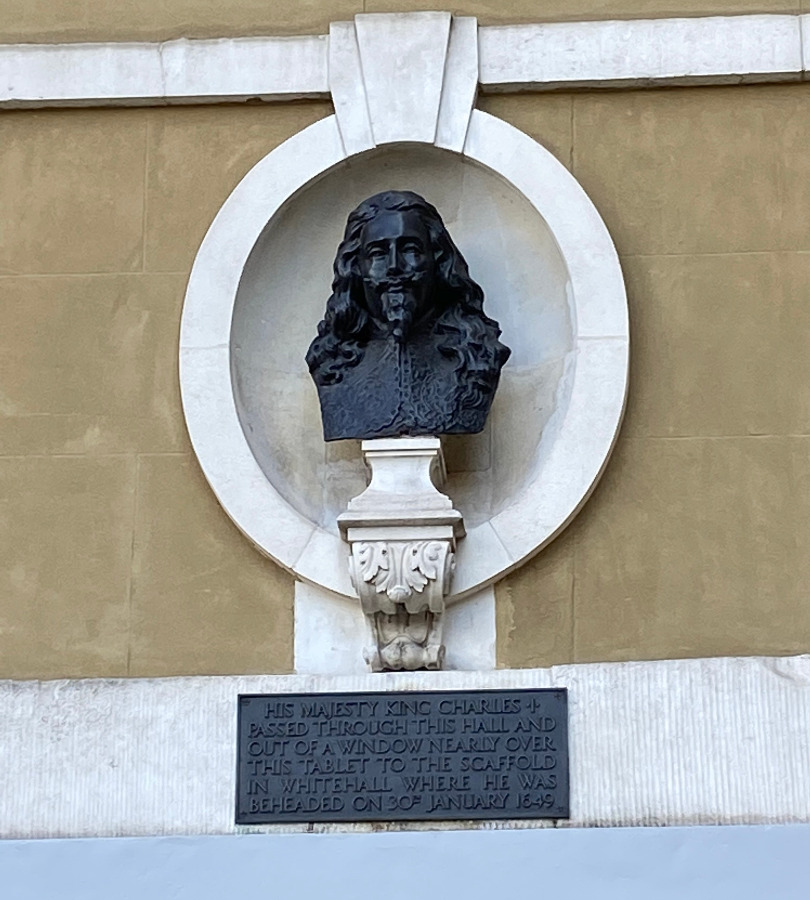
Photo: Urban Adventurer
You may have noticed that there is a black mark next to number 2 on the clock face nearby Horse Guards. That black mark is not there without reason. The black dot commemorates the execution of King Charles I. According to Britannica King Charles I went bravely to his death. He still clamed, he was a martyr to people.

Photo: Urban Adventurer
Old Place Yard

Photo: Urban Adventurer
What does Old Place Yard have to do with Bon Fire Night we are still celebrating every year? On 5 November 1605, Guy Fawkes along with his conspirators attempted to explode the Parliament and kill King James I.

He and his group transported 36 barrels of gunpowder to the cellar below the Parliament. The plan was to blow up the building on 5th November when King James I opened it. However, the plan failed. The police caught Fawkes with the gunpowder in the cellar on 4th November.
Hearing the news on the following day, people celebrated the king’s escape with fireworks all over the country.
Fawkes was imprisoned to the Tower of London to be tortured before being hanged and drowned at Old Place Yard in front of the Parliament on 31 January 1606. Fawkes body was then cut into four and sent to different parts of the country to put on display for the public to see.
This is the reason Britons celebrate Bonfire Night every year on the 5th November: to mark Fawkes failure on killing King James I.
The Elms Smithfield

Photo: Urban Adventurer
Sir William Wallace was executed here on 23 August 1305. He was one the Scotland’s greatest national heroes. He was the leader of the Scottish resistance forces during the struggle to free Scotland from the English rule.
On 5th August he was captured near Glasgow and taken to London. He was condemned as a traitor and sentenced to death. He went under the most gruesome execution imaginable. He was hung, disembowelled whilst still conscious, beheaded, and quartered. Legends say he remained silent and stoic throughout the ordeal.
Today there is a memorial not far from the scene he was executed. Even today many Sottish people pay their respect by bringing flowers to the memorial.

Photo: Urban Adventurer
The leader of the Scottish War of Independence was famously portrayed by Mel Gibson in the movie ‘Braveheart’ in 1995. The movie won the Academy Awards in the following year in various categories, such as the best picture, the best director and the best costume design.
Apart from Sir William Wallace, many others were killed at The Elms Smithfield. Wat Tyler was cut down by the Mayor of London, John Badby was burned in a barrel and Richard Rouse boiled to death.
The Devil’s Tavern
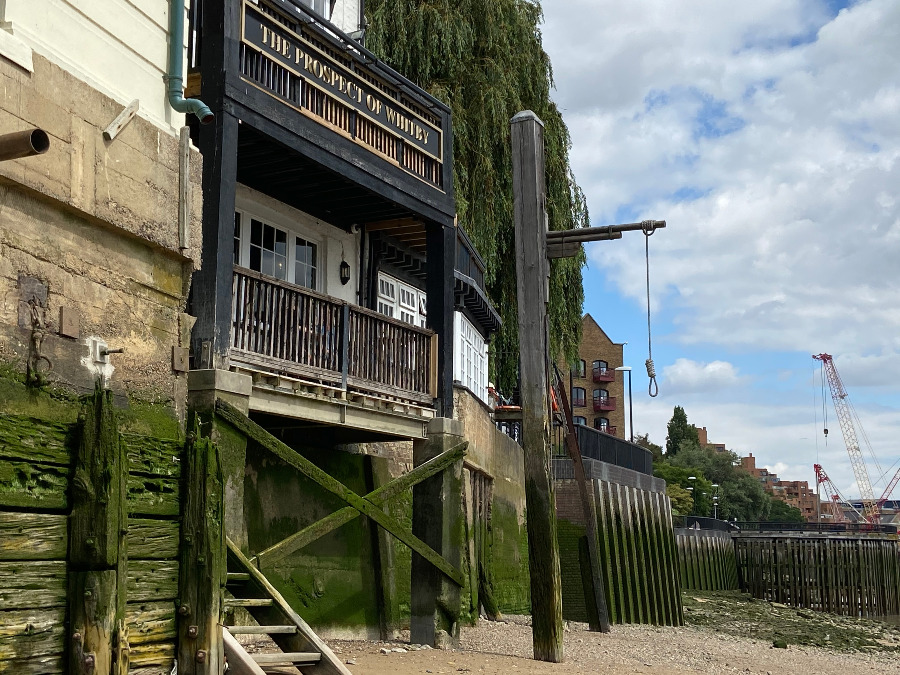
Photo: Urban Adventurer
During the middle ages until the 18th century there was a regular hunt for pirates and smugglers.
Opened in 1520, The Devil’s Tavern (today The Prospect of Whitby) is the oldest riverside inn in London, and during those old times in history it had a dubious reputation thanks to smugglers, pirates and thieves it attracted.
Located in Wapping, The Devil’s Tavern has seen a lot of pirates being hanged on the riverside.

Photo: urban Adventurer
One of them was Captain William Kidd. The famous pirate was hanged on 23 May 1701. To deter other pirates Captain Kidd was hung in a cage and his body was left there to rot for all to see along the River Themes.

There was a legend that Captain Kidd had buried all his treasure in the Caribbean. After his death generations of treasure hunters travelled to the Caribbean Islands to find his treasure. Although, the treasure has never been discovered, Captain Kidd left a story behind that inspired books, movies and even cartoons.
In the middle ages and during the 18th century a series of gibbet stood at the bank of the River Themes, called Execution Dock. A replica gibbet is still standing behind The Prospect of Whitby.

Photo: Urban Adventurer
Nearby of Captain Kidd’s execution scene a pub preserves the notorious pirate’s name. Captain Kidd pub is designed to look like a ship hulk. Old, framed newspaper articles and letters are hanging on the walls, telling the life and death of one of the most famous pirates in the world.
River Neckinger

Photo: Urban Adventurer
River Neckinger is just a stone-throw away from Tower Bridge and 20-minute walk from The Clink Prison Museum. To get there we have to walk among the walls of Shad Thames that was the largest warehouse complex in London during the 19th century.

Photo: Urban Adventurer
The river’s name is believed to come from the term ‘Devil’s neckcloth’. It’s a slang for the hangman’s noose. A ‘neckercher’ is an old word for a cravat or other covering of the neck.
Until the 18th century, Thames pirates were executed near the mouth of the inlet. The corpses then were placed on display for all to see.
The area was once notoriously filthy and described as “The very capital of cholera” and “The Venice of drains”. Large masses of rotting weed and dead animals were floating in the water which was covered with thick grease.
Charring Cross
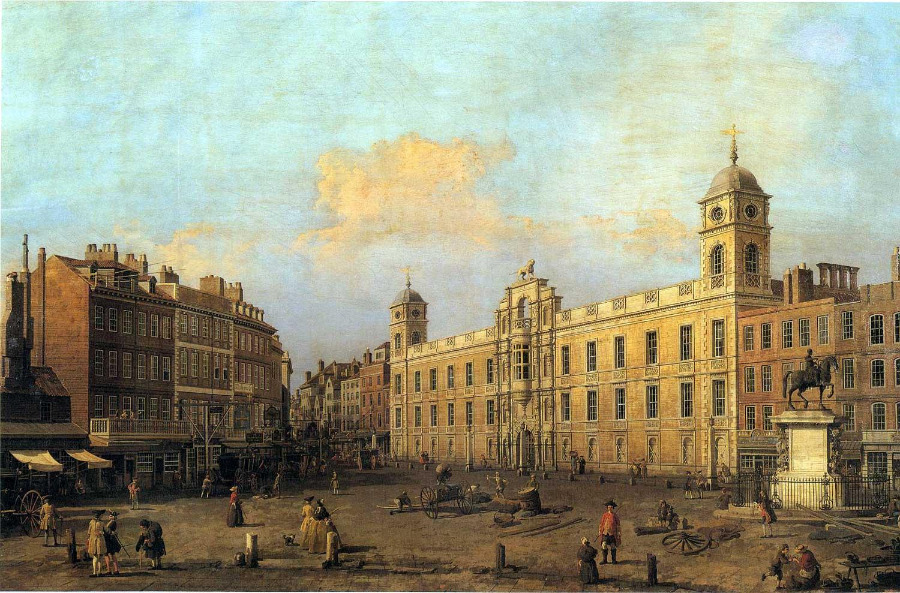
Charring Cross traditionally marks the centre of London but during the 17th century it was a location of public executions. King Charles II took revenge here against the killers of his father, King Charles I who had been beheaded in 1649 at Banqueting Hall.

Photo: Urban Adventurer
This is how Samuel Pepys the famous diarist recorded a public execution at Charring Cross he had witnessed on 13 October 1660:
“To my Lord’s in the morning, where I met with Captain Cuttance, but my Lord not being up I went out to Charing Cross, to see Major-general Harrison hanged, drawn, and quartered; which was done there, he looking as cheerful as any man could do in that condition. He was presently cut down, and his head and heart shown to the people, at which there was great shouts of joy.”
St Paul’s Churchyard

St Paul’s Churchyard is maybe a peace public park today where we go to rest and enjoy a lazy sunny day. Back then in the 17th century, however, St Paul’s Churchyard was an execution site. There were only a handful of executions taken place there, but the churchyard was held for the extreme criminals, and they were executed in the most gruesome way.

On 30 January 1606 four of the infamous Gunpowder Plotters who wanted to explode the Parliament and kill King James I – Sir Everard Digby, Robert Winter, John Grant and Thomas Bates – were hanged and disembowelled here.
Fleet Street and Flatter Lane

The corner of Fleet Street and Fetter Lane was a popular execution scene especially during the turbulent time that followed the reign of King Henry VIII. In the 1590s the junction of Fetter Lane and Fleet Street was an execution scene of Catholics, and the site remained in use until at least 1733.

Photo: Urban Adventurer
Central Criminal Court – Old Bailey

Photo: Urban Adventurer
Even the most extreme criminals stepped into the ‘Dead Man’s Walk’ with fear. Hundreds of criminals were led to gallows from the 16th century to the very beginning of the 20th century. The last execution was taken place here on 6 May 1902. George Woolfe was hanged here for murdering his girlfriend, Charlotte Cheeseman. – writes the Daily Mail in his article in 2013.

Photo Credit: Jenny Goodall
Marshalsea Prison

The Marshalsea (1373-1842) was a notorious prison in Southwark and was most famous for being the prison of the poorest debtors.
On 20 February 1824 John Dickens, father of the famous novelist, Charles Dickens was imprisoned for debt he owned for his baker. His debt was £40 and 10 shillings.
Charles Dickens was only 12 years old at that time and to support his family, was obliged to work.

Photo: Urban Adventurer
This experience had deeply touched Dickens, and this was that led him to write about debtors so often in many of his novels.
Dickens himself witnessed the public execution of Mr And Mrs Manning on 13 November 1849 at Horsemonger Lane. Following the execution Dickens sent a letter to The Times in which he depicted his experiences:
“When the two miserable creatures who attracted all this ghastly sight about them were turned quivering into the air, there was no more emotion, no more pity, no more thought that two immortal souls had gone to judgement, no more restraint in any of the previous obscenities, than if the name of Christ had never been heard in this world, and there were no belief among men but that they perished like the beasts.”
Given, London was the largest and most influential city in the country, it provided the backdrop some of most famous executions in the history.
Death penalty was abolished in 1965 and the execution sites have seen significant transformation over the centuries. Some of them became public park, underground station or a simple road junction, while others preserved their original function. There is one thing that these places share: they are said to be still haunted by those lost their lives there.
Ready for your next adventure? Visit one of London’s most haunted places if you dare, The Clink Prison Museum.