Grant Museum of Zoology has around 68,000 zoological specimens – including the world’s rarest skeleton: the quagga – dodo bones and fossils, creatures of the deep sea, a collection of preserved brains, and much more. Let’s explore!
Extinct Species, Preserved Animals and Rare Skeletons
Photo: Urban Adventurer
Grant Museum of Zoology and Comparative Anatomy was established in 1827. Since the following year, the museum has been continuously used by students at University College London (UCL). The Grant Museum of Zoology first opened to the public in 1996.
The old-fashioned museum is packed with skeletons, preserved animals in jars, skulls, mystic creatures from the deep sea and remains of species now extinct, such as bones of Dodo that went extinct in the 17thcentury; a skeleton of a quagga which was a type of zebra or an egg from an Elephant Bird. Elephant Birds were hunted to extinction in the 1700s.
Photo: Urban Adventurer
There is a different section dedicated to animals in jars. For example, monsters from the deep sea, such as Three-Toothed Pufferfish or Wolf Fish.
There is a jar full of moles – and it’s a mystery who and why made that jar -; and ‘jars of assorted specimens’, such as lizards and terrapins.
A Collection of Brains
Photo: Urban Adventurer
The brain collection is originally from the anatomical and pathological collection of Kings College London’s School of Medicine, and it consists of mammal brains (except from a single turtle), preserved in alcohol. The brains were collected from Africa, Asia, South America, Australia, and Europe. Among others, the collection consists of a brain of a dog, a monkey, a gibbon, a rabbit, and an infant tiger.
Fossils
Photo: Urban Adventurer
Grant Museum of Zoology is proud to have a number of well-reserved fossils of long extinct dinosaurs, such as Ichthyosaur, a marine reptile lived 250-90 million years ago or Pterosaur, a flying dinosaur we all know from Jurassic Park and Jurassic World blockbusters.
The Micrarium
Photo: Urban Adventurer
The Micrarium is a back-lit corner displaying over 2,000 of the tiniest microscopic specimens, all in just 2.52 square metres. The slides mostly show whole tiny animals but there are bits of bigger animals, too, for example mammoth hair.
A narrow cast iron staircase leads to the basement to Museums of Curiosities. You descend to a rabbit hole where nothing makes a lot of sense; to a different world which is bizarre and sometimes even scarry but wakes up your curiosity and makes you wanting to discover more.
The space is small and narrow but is loaded with so many oddities that, if you really want to see everything, you could spend hours down there.
Occult Cabinet, Fairies, Dead Pets, Tribal Art and More
Photo: Urban Adventurer
Museum of Curiosities is divided into multiply sections, such as ‘Cabinet of Monsters’ that includes preserved animals in jars, while ‘Fairies, Mermaids & Giants’ section includes mummified fairies, the legbone of an Irish Giant, preserved remains of a mermen and more. ‘Magick & the Occult’ section includes a fully functioning Occult Temple, a jar of moles (yes, you read it right), Woodoo artefacts from West Africa, and an occult cabinet, just to name a few.
Photo: Urban Adventurer
There are countless of other sections and artefacts to discover, including erotic-themed paintings, artworks and photos, mummified pets, a large collection of butterflies, creatures of the deep sea and human hair, including Elvis Presley’s hair, the hair of a Titanic survivor and an 18th-century human scalp.
Absinthe Parlour & Cocktail Bar
Photo: Urban Adventurer
I would highly recommend not to leave the museum without trying one of their absinthe cocktails at their absinthe parlour. Museum of Curiosities’ absinthe parlour has the largest collection of traditionally made absinthes.
Photo: Urban Adventurer
Order an absinthe fountain, sip one of their absinthe cocktails or bring home a bottled absinthe or tasting set from the bottle shop.
Interested in occultism and occult cocktails?
Then you might want to take a look around the museum’s mini shop, where absinthe glasses & spoons, books, – such as a signed copy of ‘A Grimoire of Occult Cocktails & Drinking Rituals’ – artefacts, prints and more are available to purchase.
NOTE: Due to the adult nature of some of the exhibits (dead people, erotica) under 18s are only allowed before 5pm and must be accompanied by a parent or guardian.
Locals living within walking distance with proof of address may buy £6 tickets on the door
Tuesday discount
Discounted tickets are £5 on Tuesdays (walk-in only)
OR
£2.50 on Tuesdays (walk-in only) IF you order a drink at the bar
Opening Times
Tuesday – Friday 15:00-23:00
Saturday 12:00 – 23:00
Sunday 12:00-22:00
Ready for your next adventure? Do you think you could solve the hundred-year mystery around the identity of Jack the Ripper? Visit Jack the Ripper Museum.
Located next to London Bridge station, The Old Operating Theatre is Europe’s oldest surviving operating theatre. You might remember from movie scenes when medical students gather around an autopsy table in a horseshoe-shaped room to witness an autopsy or an operation on a human body to learn about the organs and anatomy.
Well, let’s step into that movie scene…
Watch mini video tour here (coming soon).
Access Through a Spooky Narrow Spiral Staircase
Photo: Urban Adventurer
The Old Operating Theatre is an extraordinary museum in many ways, but it’s really not for everyone. Here’s why.
The museum is housed in the attic of an 18-century church. This church once belonged to St Thomas’ Hospital.
In order to get access to the museum, you have to climb a 52-steps narrow spiral staircase. This experience is spooky enough by itself for some of us to decide to quit the whole thing. It also means, that currently there is no wheelchair access to the museum.
Original Herb Garret
Photo: Urban Adventurer
The original Herb Garret used to dry and store herbs in this attic in 1822 where the operating theatre was included.
This original timber framed Herb Garret is where your theatre journey starts. Here you’ll learn more about herbs and for what and how they were used back in the 19th century and how apothecaries used those herbs to make medicines.
Horrifying Facts
Photo: Urban Adventurer
Leaving the Herb Garret your journey gets more thrilling.
You’ll learn about (the lack of) hygiene, pain relief methods and equipment used in the 19th century.
During the period the operating theatre was in use – between 1822 and 1862 – surgical equipment was rarely washed before the operation. Bandages were often reused, and surgeons washed their hands and the medical equipment after the operation rather than before. This practice caused serious infection and later the death of many patients even if the operation itself was successful. This became known as ‘ward fever’.
In the 19th century, forms of pain relief were most often alcohol or opium. Sometimes, however, surgeons administered too much or too little pain relief that resulted the patient not waking up at all after the operation or waking up throughout the operation.
Photo: Urban Adventurer
Despite of the high mortality rate, which was 30% in the 19th century, amputation was regularly performed for cases of disease, accident, or trauma. But even if the patient survived, they had to face the high risk of infection caused by that fact that surgical equipment at that time was not cleaned properly.
Before 1846, amputations were performed using a knife or saw. Many of that hair rising equipment is on display in the theatre. (I am so glad I am living in the 21st century…)
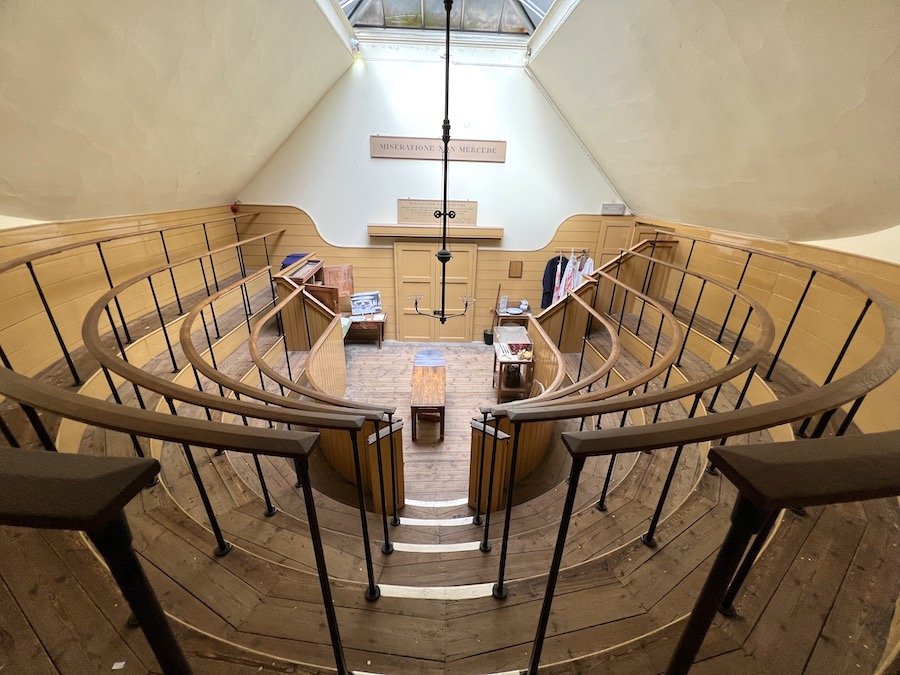
The Operating Theatre
Photo: Urban Adventurer
The next room to visit is the operating theatre itself. It’s a small horseshoe-shaped room with high glass ceiling to let as much light as possible for clearer view.
Despite of the theatre’s relatively small size, it allowed 140 people in total to witness an operation or autopsy.
Photo: Urban Adventurer
Here the exhibition gets even more interactive. If you download The Old Operating Theatre mobile app and follow the instructions, you’ll get access to an Augmented Reality experience: you’ll step into the shoes of a 19th century medical student and get fist-hand information of the latest procedures. (Don’t worry, nothing disturbing will happen during the AR experience)
Preserved Organs and Women’s Health
Photo: Urban Adventurer
Continuing your journey within the museum, you’ll get the opportunity to see some human organs floating in formaldehyde and learn more about anatomy and dissection.
You’ll learn for instance, that by the middle of the 18th century dissection of the dead had become a central to surgical education. It means that fresh human corpses had become extremely valuable in surgery to rehearse operations and educate anatomy.
Due to the extreme high demand, the number of available human bodies became limited, and this was the point when body snatchers started stealing recently buried bodies and sold them to anatomy schools.
The next section is dedicated to women’s health, focusing on birth giving. Here you’ll see a number of absolutely blood-curdling forceps, scissors, crochet hooks, and other equipment you would never want to be used on you. (Again, glad to live in the 21st century…)
Events at The Operating Theatre
There are a number of events The Old Operating Theatre hosts throughout the year.
Upcoming events for example: Surgery & the Victorian Operating Theatre Live Event, Mummies and Medicine, A Victorian Mummy Unrolling Demonstration, Victorian Gothic Tales, and there are so much more down the line.
Unique accessories that go perfectly well with your Halloween costume, such as brain stud earrings, heart stud earrings, apothecary poison bottle earrings & necklace, bone saw pedant and brooch, scull brooch, blinking doll eye necklace, keychain & hair grips, and the list goes on.
Cool! What else?
How about a graduation brain cell keyring, Coronavirus plushie, DNA plushie or uterus plushie?
Hmmm, would you try some cubed earwax, organ marmalade or olde fashioned brain jam? If you’re craving for something crunchy, I would recommend the toasted bone chunks to try. All those yummy treats from Hoxton Monster Supplies.
Apart from all of these, the shop offers lots of books, original artworks inspired by the museum, board games and more.
Practical Info
Please note: There are no public toilets onsite at the Museum.
Concessions (Students aged 17 and above, Seniors aged 60+, and Disabled Visitors): £6.00
Child 6-16 years: £4.50
Children under 6 years: Free
Carers (with a full paying adult, concession or child ticket): Free
Family (2 adults, 2 children): £18.00, additional child, £1 each
Opening Times
Thursday-Sunday | 10.30am-5pm
Ready for your next adventure? Our ‘must visit museums this Halloween’ continues. Have you read our first blog about Jack the Ripper Museum?
We use cookies on our website to give you the most relevant experience by remembering your preferences and repeat visits. By clicking “Accept”, you consent to the use of ALL the cookies.
This website uses cookies to improve your experience while you navigate through the website. Out of these cookies, the cookies that are categorized as necessary are stored on your browser as they are essential for the working of basic functionalities of the website. We also use third-party cookies that help us analyze and understand how you use this website. These cookies will be stored in your browser only with your consent. You also have the option to opt-out of these cookies. But opting out of some of these cookies may have an effect on your browsing experience.
Necessary cookies are absolutely essential for the website to function properly. This category only includes cookies that ensures basic functionalities and security features of the website. These cookies do not store any personal information.
Any cookies that may not be particularly necessary for the website to function and is used specifically to collect user personal data via analytics, ads, other embedded contents are termed as non-necessary cookies. It is mandatory to procure user consent prior to running these cookies on your website.